
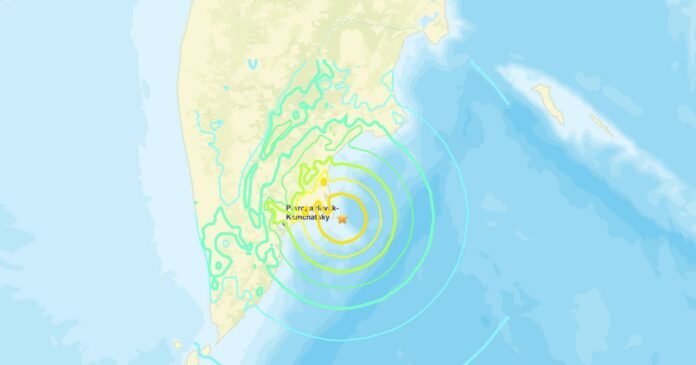

A powerful 7.4 magnitude earthquake has hit the eastern coast of Russia today. The tremor struck Russia’s Kamchatka peninsula early in the morning on Saturday, September 13, as reported by the US Geological Survey. This seismic event follows a massive 8.8 magnitude earthquake, the sixth strongest ever recorded in the area.
The USGS indicated that the epicenter of the recent quake was located 111.7 km (69.3 miles) east of Petropavlovsk-Kamchatsky, at a depth of approximately 39 km (24 miles). Despite the significant magnitude of the earthquake, no tsunami threat was issued by the US Tsunami warning system.
The Japan Meteorological Agency (JMA) has released a tsunami forecast for various areas along the Pacific coast, including Kochi Prefecture. While minor sea-level changes are anticipated, the JMA assured that there is no risk of tsunami damage, with a forecast of a tsunami less than 0.2 meters.
This earthquake is considered an “aftershock” of the previous magnitude 8.8 quake that occurred off the coast of Russia’s Kamchatka Peninsula in July. The powerful quake, originating at a depth of around 20 kilometers, ranked among the top 10 strongest earthquakes in recorded history and was the most substantial globally since 2011.
The earlier earthquake triggered tsunami warnings and evacuations in multiple regions, including Russia, Japan, and Hawaii, with advisories issued for countries as far away as the Philippines, Indonesia, New Zealand, and Peru.
The recent 7.4 magnitude earthquake last night was comparatively less disruptive. Although the US Tsunami warning system initially issued a threat post-quake, it was later canceled. The USGS reiterated that the epicenter of the latest quake was east of Petropavlovsk-Kamchatsky, 111.7 km (69.3 miles) away, at a depth of about 39 km (24 miles).
This earthquake follows the significant 8.8 magnitude quake that hit the region in July. The USGS has classified this recent quake as an ‘aftershock’ of the July seismic activity, which prompted tsunami warnings across the Pacific.
There have been no immediate reports of injuries or extensive damage, and the population residing in and around the affected area is limited, according to the USGS.
Earthquakes occur due to the movement of tectonic plates on the earth’s surface, releasing energy when they collide. The accumulated stress from this movement results in seismic waves through a faulting mechanism.
Currently, there are no tsunami warnings, advisories, watches, or threats issued by officials. The earthquake struck west of Kamchatsky, a city with a population of 181,000 people.
The Kuril-Kamchatka Arc extends approximately 2,100 km from Hokkaido, Japan, through the Kuril Islands to the Pacific coast of the Kamchatka Peninsula. This region is known as one of the most seismically active areas globally. One of the largest earthquakes in the 20th century along this arc was the 9.0 magnitude quake on November 4, 1952.