
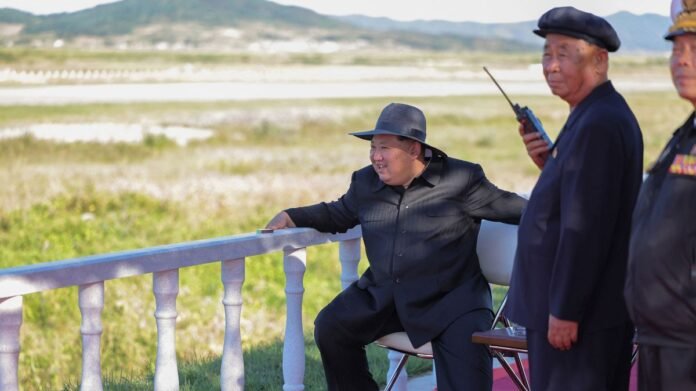

North Korea’s supreme leader, Kim Jong Un, oversaw the recent testing of military drones and urged for the incorporation of artificial intelligence and other technological advancements to enhance their operational efficiency. State Media KCNA published images of Kim inspecting a drone research facility, although the exact location remains undisclosed. The photos depicted Kim observing a drone flight resembling the US Reaper drone.
Kim has shifted his focus towards drones, naval assets, and surveillance satellites as part of his efforts to enhance North Korea’s conventional military capabilities. This strategic shift follows years of emphasis on nuclear weapons and ballistic missiles during the early stages of his rule. Recent reports suggest that Kim was preparing to deploy a “radioactive tsunami” through underwater nuclear drones.
The North Korean military, under the directive of the East Sea Fleet, has been instructed to conduct trials of nuclear-armed underwater drones. These efforts align with Kim’s push to equip the navy with nuclear capabilities, signaling potential full-scale deployment in the future. Insider sources have revealed that a government agency has mandated the readiness of the “Haeil” (tsunami) underwater attack drone.
A clandestine laboratory within the Academy of National Defence Science has been collaborating with naval units to commence trial drone operations for the “Haeil.” This large torpedo-type drone, measuring approximately 13 meters in length and 1.5 meters in diameter, is designed to carry a nuclear warhead. The outcomes of the trial operations will determine the drone’s technical combat specifications and its potential for nuclear armament.
North Korea has conducted multiple tests of the Haeil since 2023, describing it as a weapon capable of clandestinely approaching and devastating enemy vessels or ports with a “radioactive tsunami” generated by an underwater explosion. However, doubts persist regarding the drones’ actual capability to produce the “super-scale radioactive tsunami” as claimed by Pyongyang.
While the effectiveness of the Haeil in combat remains uncertain, military authorities view it as a strategic asset for potential nuclear retaliation and infiltration of enemy strongholds. The acquisition of such a weapon, capable of underwater detonation in critical locations, is seen as a demonstration of naval power, instilling hope and confidence within the military ranks.
Moreover, North Korea is reportedly constructing its largest warship, raising concerns about the nation’s offensive capabilities. Recent satellite images indicate the development of a highly advanced warship in North Korea’s fleet, sparking apprehensions about the country’s military progress.
The discovery of a covert military base near the Chinese border has further fueled speculations about North Korea’s military capabilities. Located in North Pyongan Province just 17 miles from China, the base is suspected to potentially house devastating missiles.