
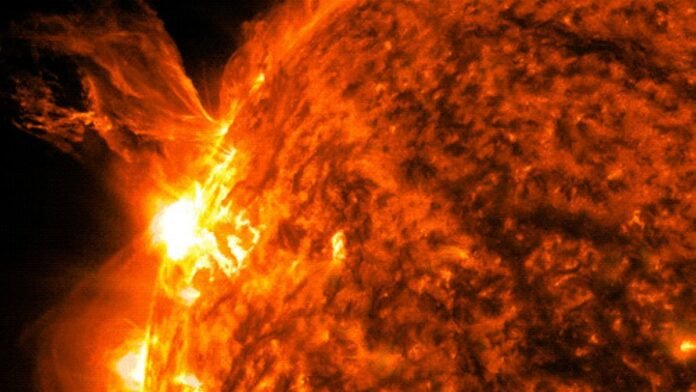

NASA has raised concerns about a potent solar flare that could impact Earth’s electrical grids. The US space agency indicated that these intense X-class bursts occurred following solar emissions on November 30. Images of the event were captured by NASA’s Solar Dynamics Observatory spacecraft, which monitors the Sun continuously. While solar flares can create stunning aurora displays, they also have the potential to disrupt critical services.
These eruptions can lead to coronal mass ejections (CME), releasing plasma and magnetic fields that may trigger geomagnetic storms when directed at our planet. NASA reported that a significant solar flare peaked at 9:49 p.m. ET on Nov. 30, 2025, classified as an X1.9 flare. Such events can impact radio communications, power grids, navigation systems, and pose risks to spacecraft and astronauts.
Geomagnetic storms, as outlined by the Met Office, can have physical and technological consequences. These storms are initiated by solar wind bursts, streams of charged particles like electrons and protons emanating from the Sun. When these particles interact with Earth’s magnetosphere, a protective magnetic shield, disturbances can occur, resulting in geomagnetic storms. These solar events can travel to Earth within 18 to 96 hours and have effects lasting several days on arrival.