

A British individual who relocated to Australia was instructed to depart the country permanently due to a series of heinous crimes. Frank Gardiner, a notorious bushranger, was banished from Australia in the 1870s for his involvement in criminal activities. Gardiner, along with a group of lawbreakers, had been causing chaos in the country.
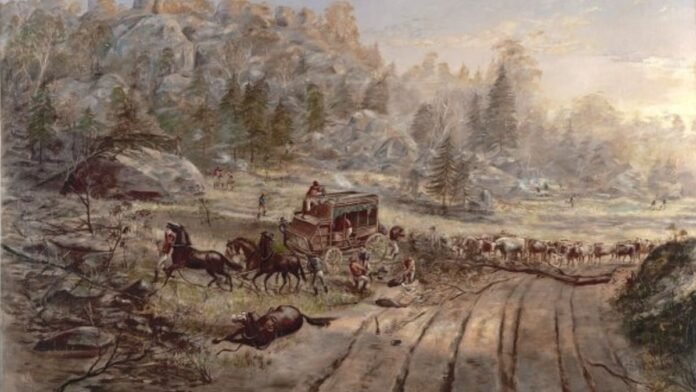
Gardiner gained infamy for leading the largest gold robbery in Australian history at Eugowra, New South Wales. His gang, known as the Gardiner-Hall gang, stole a substantial amount of cash and approximately 77kg of gold, valued at around £5 million today. These bushrangers were notorious for robbing banks, attacking coach services, and looting estates, often engaging in confrontations with colonial police.
The Gardiner-Hall gang comprised several criminals, including Gardiner, Ben Hall, Fred Lowry, Michael Burke, John O’Meally, Henry Manns, Johnny Gilbert, and John Dunn. Many of these bushrangers met violent ends, with some being shot by police or by their own hand, while others were executed by authorities.
Born as Francis Christie in Scotland, Gardiner migrated to Australia as a child in 1834. He initially worked as a stockman but later turned to a life of crime, engaging in horse theft and other illegal activities. Despite multiple arrests and imprisonments, Gardiner continued his criminal pursuits, forming alliances with other outlaws like John Peisley and Ben Hall.
After orchestrating a major gold robbery at Eugowra, Gardiner fled to Queensland before eventually being apprehended by police outside their jurisdiction. He was sentenced to 32 years of hard labor and eventually accepted a deal to be released early on the condition of exile from Australian colonies and New Zealand, leading him to relocate to the United States in 1874.
In the U.S., Gardiner operated a saloon in San Francisco and became a well-known figure among Australian immigrants. Little is known about his later years, with reports of his death in 1882 and speculation about his burial in a pauper’s grave in San Francisco. The circumstances of his death remain uncertain, partly due to the loss of records during the 1906 San Francisco earthquake.