
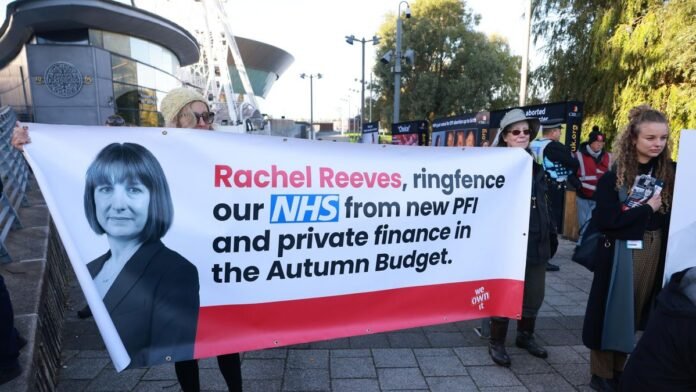

Many Members of Parliament are calling on Chancellor Rachel Reeves to abandon the proposal to reintroduce private debt arrangements for the NHS. Activists approached MPs outside the Labour Party Conference, urging them to uphold their commitment from the 2024 election manifesto to maintain the NHS as “publicly owned and publicly funded.” Private finance agreements are utilized to keep government debt off the records to adhere to fiscal regulations, but they result in NHS trusts facing exorbitant interest rates for extended periods. According to campaigners, this approach is akin to purchasing a new house using a payday loan.
The demonstration occurred just before Rachel Reeves delivered her keynote address at the conference held in Liverpool.
A final decision on whether to employ a form of private finance scheme to fund numerous new medical centers across England will be made by the Chancellor in her Autumn Budget on November 26.
Cat Hobbs, the founder of We Own It, which orchestrated the protest, expressed to the Mirror: “It is a complete breach of the manifesto and does not align with what people voted for Labour to accomplish. People voted for Labour to safeguard the NHS and because they entrusted them with its care. Proceeding with this plan would be a betrayal of that trust.”
The introduction of public-private partnerships (PPPs) was initiated by the Conservatives, and then expanded by Tony Blair’s Labour government through private finance initiatives (PFI) to construct hospitals without increasing the national debt.
In contrast to the government’s ability to borrow at lower rates, NHS trusts engage in direct borrowing from private consortiums under PFI agreements at significantly higher interest rates. Shareholders often realize double-digit returns from such schemes.
For instance, Barts Health NHS Trust in London is locked into a 43-year PFI contract, through which it is estimated to repay over £7 billion for assets and services valued at £1.1 billion. The Norfolk and Norwich Hospital is expected to repay 14.7 times the initial PFI investment cost. Servicing PFI debts can consume between 10% and 15% of a hospital trust’s funding.
The government is contemplating the utilization of a variant of PPP to meet Rachel Reeves’ self-imposed regulations, including a stipulation that public debt must diminish as a portion of the economy within five years.
Activists brandishing placards confronted MPs with a five-foot tall sign that read: “Are you a Labour MP? Do you stand by Labour’s manifesto pledge that the NHS will ‘always be publicly owned and publicly funded?’”
The protest featured a list of all Labour MPs with a space for them to affirm their commitment, and 27 MPs signed in agreement.
Cat Hobbs reiterated: “Currently, NHS trusts are still allocating up to 13% of their income to outdated PFI agreements arranged during Blair’s tenure. In some instances, this surpasses the amount spent on medications by the hospital. Most of these aged PFI agreements have already covered the hospital’s construction costs but persist due to exorbitant interest rates. Private finance arrangements are an extremely inefficient method of funding, and if Rachel Reeves proceeds, she will heavily encumber the NHS.”
He likened the situation to someone with sufficient funds to buy a house opting to use a payday loan instead.
The NHS 10-year plan outlined a commitment to “develop a business case for the use of public-private partnerships (PPPs) for neighborhood health centers, pending a final decision at the autumn budget.”
New PPPs would be more regulated than the large-scale projects during the Blair era but are being contemplated “in limited scenarios where they could offer value for money.” Scotland and Wales have devised their own alternative PPP approaches, known as “nonprofit distributing” partnerships and the “mutual investment model,” respectively.
Bell Ribeiro-Addy, Labour MP for Clapham and Brixton Hill, emphasized: “Protecting our NHS is paramount. It is a cornerstone of our nation, and the best way to safeguard it is by ensuring it remains fully publicly funded and accessible when needed. Surrendering further control to PFI is a detrimental path, and as the party that established the NHS, I hope Labour would shield it from these malevolent private entities.”
Ian Byrne, Labour MP for Liverpool West Darby, remarked: “Having witnessed the detrimental effects of PFI on the NHS during my time as a Trade Union organizer, I strongly oppose this direction