
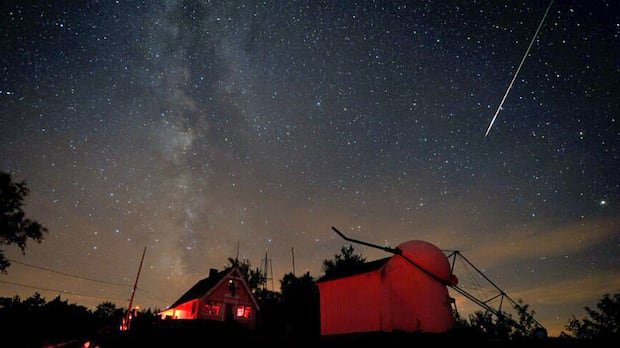

August brings one of the most anticipated meteor showers of the year – the Perseids. This year, the peak of the shower coincides with a partial solar eclipse.
The Perseids are renowned for their abundance and brightness, making it a favorite among meteor enthusiasts. The best viewing night falls on Aug. 12-13, coinciding with a new moon, ensuring optimal conditions for spotting meteors.
Peter Brown, a professor at Western University, highlighted the expected presence of Earth-grazers this year – meteors that enter Earth’s atmosphere and then shoot back into space, known for their brightness and speed.
The Perseids are set to peak around midnight Eastern Daylight Time, potentially showcasing up to 120 meteors per hour under ideal dark-sky conditions. While such numbers might not be fully visible, viewers can still anticipate seeing a good number of bright meteors.
Meteor enthusiasts are encouraged to start observing early, with the shower starting from 10 p.m. onwards. The radiant point of the Perseids is in the constellation Perseus, visible in the eastern sky after sunset.
The shower began on July 17, gradually intensifying as it approaches its peak. Weather permitting, viewers are advised to find a dark location away from light pollution, allowing their eyes to adjust for optimal meteor spotting.
Apart from the Perseids, the southern delta Aquariids, alpha Capricornids, and kappa Cygnids meteor showers are also active, offering additional opportunities to witness shooting stars.
Additionally, on Aug. 12, a partial solar eclipse will be visible across Greenland, Iceland, and parts of Spain and Portugal. While Canada won’t experience a total eclipse, a partial eclipse will still be observable, with the extent varying by location.
Viewers interested in observing the partial solar eclipse should do so cautiously using approved solar eclipse glasses to protect their eyes. Astronomers emphasize the educational value of witnessing such celestial events, showcasing the intricate motions of Earth, moon, and sun.