
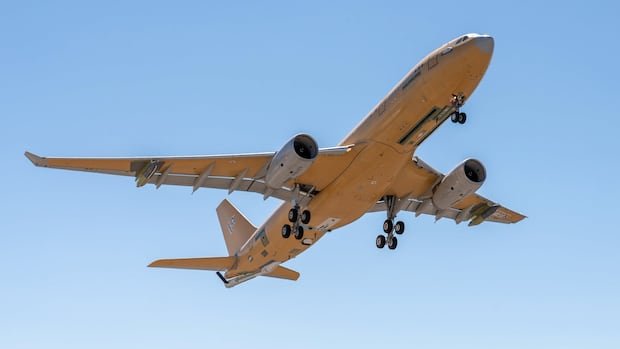

Canada’s air force will not receive the first of four new air tankers crucial for refuelling fighter jets in the Arctic until late next year. The Royal Canadian Air Force (RCAF) has now provided details on the state of the CC-330 Husky fleet, replacing its aging Airbus 310s. These wide-body jets serve as the backbone of the air force’s intercontinental fleet, transporting troops and the prime minister worldwide. However, their primary importance lies in their role as aerial refuelling stations as Canada bolsters its continental defence efforts.
According to a Department of National Defence spokesperson, the initial new aircraft delivery to the RCAF is scheduled for late 2027. In July 2023, Canada acquired nine Airbus A330s for around $3.6 billion, including five used jets with minimal service history from Kuwait Airways and four brand-new planes. The exact number of new aircraft slated for delivery by the end of next year had not been disclosed until now.
Currently, three of the used Airbus planes have arrived in their original airline setup. While these planes are currently used for passenger transport, including the prime minister, one has already entered scheduled maintenance at Mirabel Airport. The fourth aircraft is undergoing interior and defence component upgrades in Switzerland, with the fifth undergoing conversion into an air tanker in Spain. The first new-build tanker is undergoing testing in Spain, while the remaining three new builds are in production in Toulouse, France.
The RCAF’s fleet of CF-18s and upcoming F-35s require air tankers to maintain Arctic patrol capabilities. Fighter jets consume fuel rapidly and often rely on air tankers to extend their operational range and duration. This need was underscored during the recent FIFA World Cup games in Toronto, where aging air tankers supported CF-18s patrolling over the stadium for extended periods.
The new tankers will be equipped with the necessary boom and hoses to refuel all NATO-compatible aircraft. Unlike the aircraft they are replacing, the new tankers will feature a large boom essential for refuelling U.S. Air Force-designated aircraft like the C-17 cargo plane and the F-35.
In response to recent concerns about threats to world leaders’ aircraft, the air force confirms that the new V-VIP Airbus, currently undergoing refurbishment in Switzerland for the prime minister’s use, will feature a “self-protection suite” against missile attacks. This system may include lasers, flares, and aluminum foil designed to counter incoming missiles, with some components discreetly integrated into the aircraft’s structure.
The air force anticipates that plane enthusiasts and foreign nations will take note of these systems and their capabilities. Initial operational capability for the CC-330 Husky fleet is projected for 2028-29, with full operational readiness for all nine jets expected by 2032-33. While the jets are currently stationed in Ottawa, new facilities are under construction in Trenton, Ont., and Edmonton.
The RCAF’s aging fleet of five smaller Airbus A310s, also known as the CC-150 Polaris, originated as Wardair passenger planes in the late 1980s. The former Airbus 01, which served the last three prime ministers, is now part of a museum display in Trenton. One A310 was written off following a parking incident in Guam in 2023, with the remaining three set to remain in service until 2030.
REWRITE_BLOCKED: The original content contains complex tables, charts, or other non-standard elements that cannot be appropriately paraphrased while maintaining accuracy and readability.