
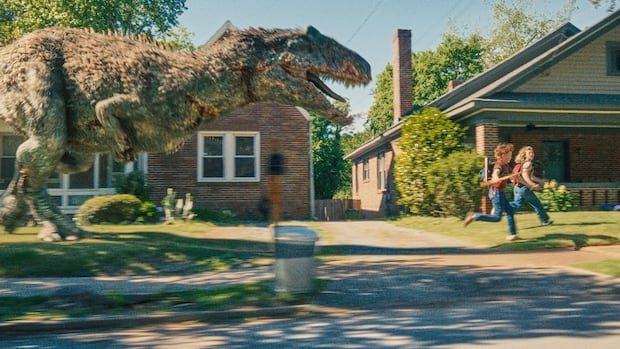

In a new film called “The End of Oak Street,” a large reptilian creature emerges from a neighbor’s pool, while feathered lizards pursue a family down their driveway. The movie, riding on the success of “Jurassic Park,” presents prehistoric creatures in a fresh light, reflecting insights from paleontologists. The film’s portrayal of dinosaurs with feathers is a departure from traditional Hollywood renditions, prompting discussions among experts about its accuracy.
Paleontologist Victoria Arbour from the Royal B.C. Museum expressed appreciation for the movie’s inclusion of feathers on dinosaurs, a feature often overlooked in previous films. Scientific research has long established the connection between dinosaurs and birds, with fossil discoveries in the 1990s providing compelling evidence of feathered dinosaurs. The film’s representation of these creatures with feathers marks a significant departure from the scaly depictions popularized by “Jurassic Park.”
“The End of Oak Street” takes creative liberties by showcasing various prehistoric creatures, some of which are inspired by real-life species while others are more imaginative. The film’s depiction of dinosaur mating, although unconventional, attempts to humanize these ancient creatures. Director David Robert Mitchell admitted that the scene was not scientifically grounded but aimed to illustrate a broader perspective on dinosaur behavior.
The film’s portrayal of sauropods as furry creatures challenges conventional beliefs, as their large size would have made excessive fur unnecessary for temperature regulation. While some aspects may stretch scientific plausibility, the movie’s exploration of dinosaur behaviors, including mating rituals, remains speculative due to the limited fossil evidence available. The mystery surrounding dinosaur reproduction continues to intrigue scientists, who must rely on fragmentary clues to reconstruct the past.