
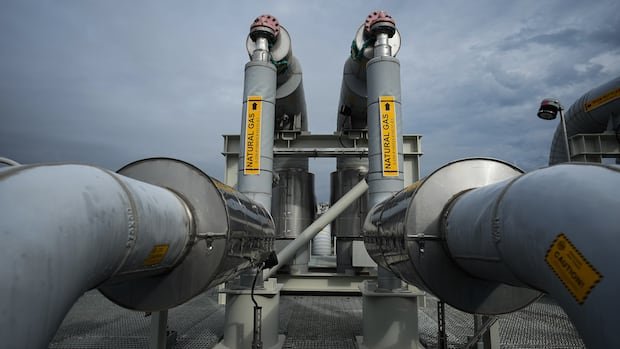

In a recent address, Prime Minister Mark Carney emphasized the crucial role Canada plays in fueling American growth through its exports of natural gas to the United States. The question arises: What impact would halting these shipments have on the cross-border trade dynamics?
Despite the ongoing Canada-U.S. trade tensions, energy products like oil and natural gas have not been utilized as bargaining chips. The concept remains contentious, with Alberta Premier Danielle Smith consistently opposing it, while Ontario’s Doug Ford advocates for keeping all options open.
Carney highlighted the significance of Canada’s energy exports to the U.S., stating that Canada supplies 99% of their natural gas imports, 85% of their electricity imports, and 60% of their crude oil imports. While the U.S. heavily relies on Canadian energy, data from the U.S. Energy Information Administration reveals that Canadian natural gas imports accounted for nearly all non-domestic supply in 2025, but only about 8% of total U.S. consumption.
Dulles Wang, the director of Americas gas and LNG at Wood Mackenzie, estimates that Canadian natural gas deliveries to the U.S. make up around 5% of America’s domestic production. Despite this relatively small percentage, the geographical distribution of these deliveries is crucial. While Texas produces more gas than it consumes, regions like the Pacific Northwest heavily rely on Canadian gas for over 90% of their supply.
Halting natural gas exports to the U.S. would have severe repercussions for Canada’s energy industry, potentially leading to a surplus of supply, plummeting prices, and economic downturn. The move could negatively impact Canada by eliminating its primary customer and causing price crashes, underscoring the crucial role of U.S. exports in the Canadian energy sector’s stability and growth.