
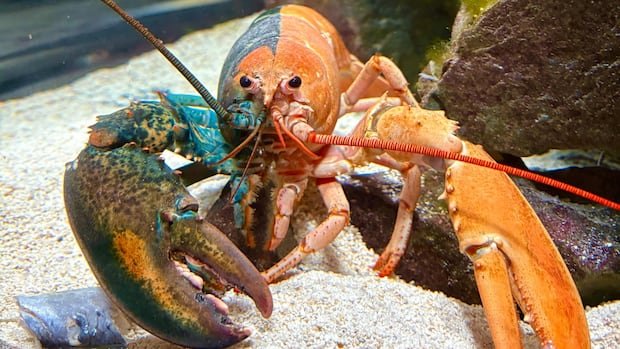

A unique lobster caught by veteran lobster fisherman Robert Wagner recently made headlines in Nova Scotia. The lobster, named Oscar, had a striking split coloration of blue and orange, a rare mutation occurring in about one out of every 50 million lobsters.
Wagner and his family cared for Oscar before donating him to Dalhousie University’s Beaty Centre for Marine Biodiversity. Nadia Stewart, a facilitator at the center, mentioned that lobsters with such distinct colors are often preyed upon in the wild due to their visibility. Stewart explained that Oscar’s genetic mutation resulted from the fusion of two sets of fertilized unlaid eggs.
After being transported to the university, Oscar adapted well to his new environment. Staff were surprised when he shed his shell, a process that occurs periodically for lobsters as they grow. Oscar’s old blue-orange shell was put on display, and he was given time to recover before returning to public view once his new shell hardened.
Wagner expressed gratitude for Oscar being in good hands and hoped for his continued well-being. The unique lobster’s story has captured the attention of many, shedding light on the rare occurrence of such genetic anomalies in marine life.