
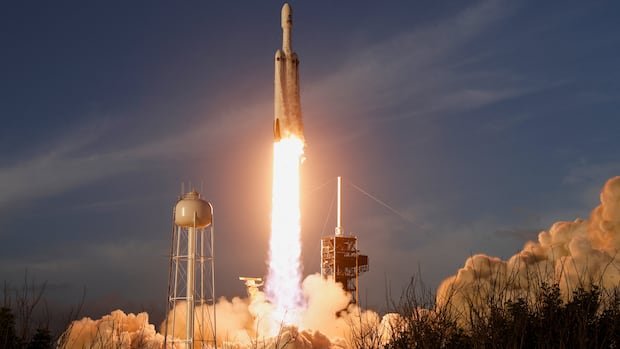

NASA initiated a new venture to explore significant puzzles in astrophysics and cosmology by launching the U.S. space agency’s latest flagship astronomical observatory known as the Nancy Grace Roman Space Telescope. Costing around $4 billion, the telescope was sent into orbit from NASA’s Kennedy Space Center in Cape Canaveral, Florida, aboard a SpaceX Falcon Heavy rocket amidst clear blue skies shortly after sunrise. Scheduled for a five-year mission, NASA mentioned the possibility of extending the telescope’s operations for an additional five years.
Designed to delve into cosmic mysteries like dark energy and dark matter, as well as examine gravity on a grand scale and seek out exoplanets, the telescope will position itself in orbit beyond the moon. The observatory, originally intended for a spy satellite program under the National Reconnaissance Office, was repurposed by NASA for cosmic exploration after the original program faced budget issues and was terminated.
Named after NASA’s first chief astronomer, also known as the “mother of the Hubble Space Telescope,” the Roman telescope will journey towards an orbital destination called Lagrange Point 2, situated approximately 1.6 million kilometers from Earth. Over the next 90 days, mission scientists will commission the telescope and ready it for scientific operations. The telescope is anticipated to transmit its initial high-resolution images before the winter holidays, as stated by Roman telescope project manager Jackie Townsend.
NASA Administrator Jared Isaacman expressed confidence that the Roman telescope will achieve household recognition akin to other renowned orbiting observatories like the James Webb Space Telescope and the Hubble Space Telescope. The telescope is expected to provide a wide-angle view of the cosmos at a pace faster than the Hubble Space Telescope, enabling it to survey the entire Milky Way galaxy within a month, a feat that would take the Hubble a century to accomplish.
By creating an elaborate 3D map of the universe, the Roman telescope aims to enhance understanding of dark energy and dark matter, two enigmatic cosmic components. The telescope’s primary survey, which will span over a year, is set to cover more than two billion galaxies. Scientists anticipate that by scrutinizing dark matter’s gravitational pull and dark energy’s expansive force across the universe, the telescope will bring them closer to unraveling these cosmic mysteries.
Moreover, the Roman telescope will undertake an extensive search for exoplanets, expecting to identify numerous new planets and offer the first statistical overview of planetary systems resembling our own.