
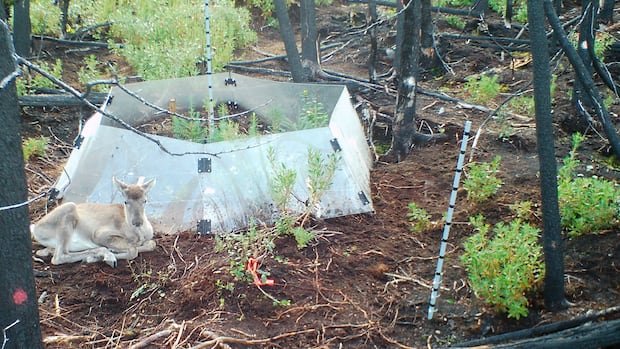

Wildlife in Newfoundland’s forests has been wreaking havoc on the research equipment of Lucas Brehaut, a wildfire scientist studying forest regrowth post-fire. His team uses open-top chambers to monitor seedlings’ growth in a warming environment due to climate change. However, the equipment has fallen victim to curious animals like moose, bears, and lynx, causing damage and even theft of sensors.
Despite facing challenges like difficult terrain and harsh weather, Brehaut’s main adversaries turned out to be the local wildlife. The interference has led to disruptions in the research process, with some sites consistently being targeted by animals. While some creatures graze peacefully, others have destroyed the equipment, complicating the study’s progress.
Kaitlyn Gaynor, a professor specializing in animal behavior, explains that animals are naturally drawn to novel objects in their environment out of curiosity or potential food sources. In Brehaut’s case, the animals have not only disrupted his research but have also posed significant challenges to the study’s continuity. Gaynor suggests minimizing human scent on equipment and camouflaging it to reduce animal interference.
Similar incidents of animal disruption have been observed globally, such as in Mozambique, where baboons and hyenas have tampered with research equipment. Elephants, known for their destructive behavior, pose a significant threat to research equipment due to their size and intelligence. Ultimately, animals remain a significant factor in research equipment loss and failure, alongside human interference.
Despite these setbacks, Brehaut maintains a positive outlook, acknowledging that animals are merely enjoying their natural habitat. While the interference poses challenges, it underscores the importance of coexisting with wildlife in their environment.