
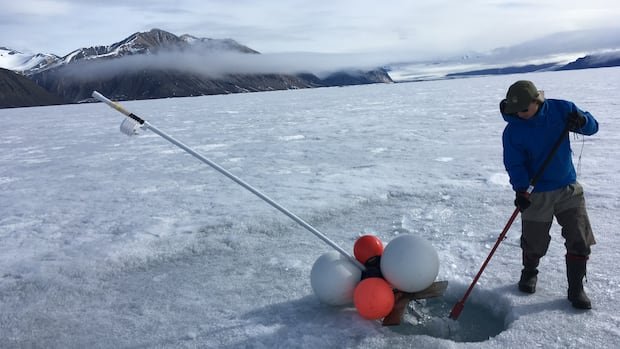

Canada’s last epishelf lake, a unique ecosystem of freshwater floating on saltwater, has disappeared along with the diverse life it harbored, as confirmed by scientists in a recent study. Jérémie Bonneau, an assistant professor at Laval University in Quebec City and the lead author, expressed sorrow over the loss of the Milne Fiord epishelf lake on Ellesmere Island in Nunavut, emphasizing its distinction as the final such feature in Canada.
The abrupt vanishing of this once prevalent natural phenomenon underscores the impact of a warming climate on the Arctic region, according to Bonneau. While the demise of the lake had been previously reported, the newly published study in Scientific Reports delves into the specifics of its disappearance, describing it as an irreversible event marking the end of a 4000-year era.
Epishelf lakes, formed when freshwater accumulates on top of denser saltwater due to natural barriers, create distinct ecosystems. The Milne Fiord lake, concealed beneath a layer of ice, hosted separate communities of bacteria, viruses, and phytoplankton thriving in the freshwater and saltwater layers. The lake’s unique biodiversity, including previously unknown Arctic microbes, highlighted its ecological significance.
In 2020, the collapse of the Milne Ice Shelf off Ellesmere Island’s coast led to the lake’s sudden drainage into the ocean. Following this event, researchers observed the rapid disappearance of the freshwater within the fiord, leading to the demise of its inhabitants adapted to the former conditions. The transformation from a freshwater lake to a saltwater fiord underscores the dynamic changes unfolding in the Arctic due to environmental shifts.
With epishelf lakes now extinct in Canada, similar ecosystems in Greenland and Antarctica face an uncertain future. Scientists warn that these delicate habitats are increasingly threatened by climate change, signaling a concerning trend for the preservation of unique ecosystems worldwide.