
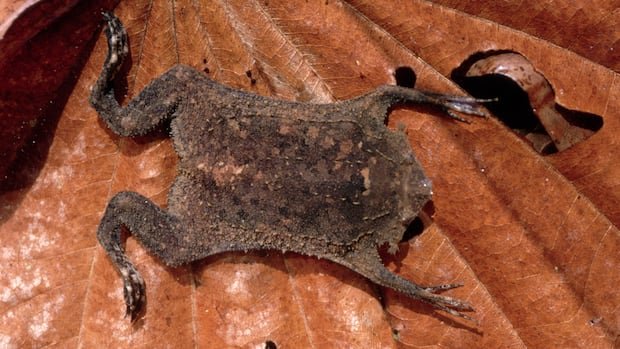

A unique ability of the Surinam toad has been unveiled by scientists in California. Despite its unusual appearance and limited vision, this toad is a skilled hunter capable of detecting and capturing prey swiftly in its murky environment.
The key to its hunting success lies in its fingertips, which function as highly sensitive touch organs. Through a recent study, researchers found that the star-fingered toad uses its fingertips to sense the subtle movements of water caused by nearby prey. These specialized fingertips, with intricate fractal patterns of lobes, resemble the high-resolution sensors found in the human eye’s fovea.
With 128 tiny lobes across its fingertips, the toad’s skin is equipped with an abundance of touch-sensitive papillae, enhancing its tactile sensitivity. Remarkably, these fingertips contain a significant concentration of touch-sensitive nerves, enabling the toad to perceive the size and proximity of potential prey without direct contact.
This discovery sheds light on a remarkable adaptation in the toad’s sensory system, demonstrating a strategy akin to complex mammalian brains. Despite evolutionary differences spanning millions of years, both frogs and mammals have converged on a similar solution to optimize sensory information processing in specific body regions.
The implications of this research extend beyond the amphibian realm, offering insights into the evolutionary mechanisms that underpin sensory processing in vertebrates. By unraveling how different species have evolved distinct neural pathways, scientists are gaining valuable insights into the diverse strategies employed by animals to navigate their environments effectively.