
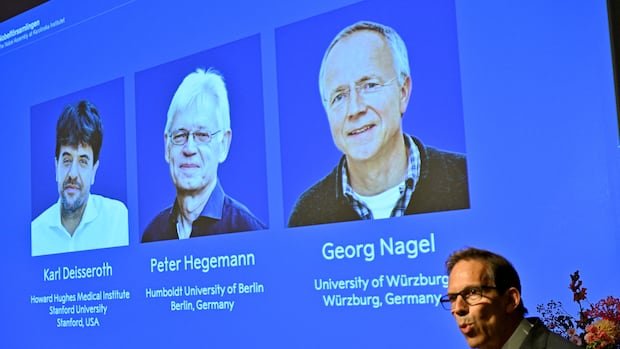

Karl Deisseroth, Peter Hegemann, and Georg Nagel were awarded the 2026 Nobel Prize in Physiology or Medicine for their groundbreaking work on light-gated ion channels and optogenetics, announced the Nobel Assembly in Stockholm. Optogenetics enables the manipulation of individual nerve cell activity within a live brain, shedding light on the brain’s complexities and secrets, as stated by Thomas Perlmann, the Nobel Assembly’s secretary general.
The trio, comprising 54-year-old American Deisseroth, 71-year-old German Hegemann, and 73-year-old German Nagel, expressed their joy at receiving the esteemed award together, emphasizing the honor of sharing it with their esteemed colleagues. The Nobel Prize carries a monetary award of 12 million Swedish crowns ($1.7 million Cdn), which will be divided among the three scientists. Deisseroth is affiliated with Stanford University in California, Hegemann with Humboldt University in Berlin, and Nagel with the University of Würzburg in Germany.
The impact of optogenetics in neuroscience is profound, offering new insights into how the brain processes information and the interactions among different neurons across the brain, noted Anna Wedell, a genetics professor and Nobel committee member. In ongoing clinical trials, optogenetics shows promise in restoring vision to individuals affected by retinitis pigmentosa by integrating light-sensitive proteins into the retina. Researchers foresee potential advancements in cochlear implants through optogenetics, enabling more precise stimulation of the auditory nerve compared to existing electrical devices.
The journey towards these remarkable achievements dates back to the early 1990s when Hegemann explored the light responsiveness of the alga Chlamydomonas, leading to the discovery of channelrhodopsin-2, an ion channel activated by light. Their research culminated in Deisseroth demonstrating the application of optogenetics in rat nerve cells in 2005, marking a significant milestone in the field of neuroscience.
The Nobel Prizes for chemistry and physics are scheduled for Tuesday and Wednesday, respectively, while the literature prize will be awarded on Thursday, followed by the peace prize on Friday. Alfred Nobel, the Swedish chemist and innovator, bequeathed his estate towards establishing the Nobel Prize to honor individuals who have made significant contributions benefiting humanity, with the laureates receiving their awards on December 10, the anniversary of Nobel’s death.