
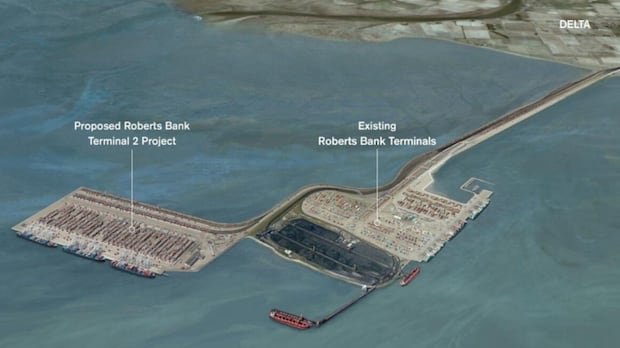

The Canadian government is progressing with the procedure to potentially categorize the Roberts Bank Terminal 2 port extension in Metro Vancouver as a project of national significance. A notification released in the Canada Gazette on August 29 initiates a 30-day consultation period to deliberate on including the port expansion as a project of national importance under the Building Canada Act. This legislation enables projects identified as being in the national interest to undergo an accelerated approval process, including environmental assessments.
The Liberal government, in its announcement regarding the potential listing of both the terminal and the Mackenzie Valley Highway project in the Northwest Territories, emphasized the potential benefits of enhancing Canada’s transportation and trade networks and bolstering the country’s long-term economic autonomy. Nonetheless, environmental organizations are apprehensive that expediting the port expansion could lead to circumventing environmental safeguards.
The Roberts Bank Terminal 2 (RBT2) port expansion initiative, spearheaded by the Vancouver Fraser Port Authority, proposes a three-berth container terminal that would augment the port’s capacity by nearly 50% and facilitate approximately $100 billion in annual trade volume, according to the port authority. In 2023, the federal government granted approval for the project, subject to 370 legally binding conditions aimed at addressing environmental concerns. Concurrently, British Columbia issued an environmental assessment certificate for the project in the same year, incorporating 16 additional conditions.
Both levels of government, acknowledging the likelihood of significant adverse environmental impacts from the project, deemed the approvals justified in the circumstances. The RBT2 project is presently in the process of securing final environmental permits, including the requisite authorization from Fisheries and Oceans Canada concerning compliance with the Species at Risk Act (SARA).
Should the project be accorded national-interest status, Carney’s cabinet could potentially acquire discretionary authority to exempt it from SARA obligations. Prime Minister Mark Carney previously announced $10 billion in federal backing for the expansion project as part of a broader agreement with British Columbia. The proposed expansion is slated for construction in the Fraser River estuary, a habitat that conservationists assert is crucial for the survival of numerous species, many of which are endangered.
Environmental Defense’s Julia Levin, serving as the associate director of national climate, highlighted the significance of the estuary ecosystem as a critical breeding ground for over a hundred at-risk species. The placement of a mega port in this biodiverse estuary, resulting in the destruction of nearly 200 hectares, raises concerns among environmentalists regarding the potential impact on vital chinook salmon habitats and the southern resident killer whales.
Southern resident killer whales, encompassed within the more than 600 wildlife species listed under SARA, face significant threats, with only 75 individuals remaining. Chinook salmon, a primary food source for the southern residents, have seen their habitat shrink by around 85% due to developmental activities and infrastructure projects. In response to environmental apprehensions, the port authority outlined plans to restore 102 hectares of habitat in collaboration with First Nations to support key species such as juvenile Chinook salmon and Dungeness crab.
Additionally, the port authority emphasized measures to safeguard southern resident killer whales, such as implementing ship slowdown programs to mitigate underwater noise. British Columbia’s Environmental Assessment office underscored the stringent conditions in place, affirming that the project would be closely monitored for adherence to all provincial requisites throughout its lifespan.
The federal government has proposed allocating $258 million over five years to safeguard whales and their habitats, with a specific focus on protecting southern resident killer whales. However, environmental groups, including Levin, contend that the government’s expedited handling of these projects prioritizes construction at any cost, potentially jeopardizing the welfare of the southern resident killer whales and the environment.
Critics, like Levin, argue that the government’s moves to fast-track projects and amend environmental regulations, including the Species at Risk Act, could undermine environmental safeguards and species protections to facilitate the construction of major ventures. The alterations being contemplated could diminish the efficacy of the Species at Risk Act, leaving species vulnerable to further threats.
Noteworthy proposals include exempting specific projects from the Species at Risk Act’s “jeopardy test,” a move that has elicited criticism from various stakeholders. The engagement period for discussing these potential changes was extended following feedback from First Nations and environmental organizations, urging the government to carefully deliberate on the implications of such alterations.