
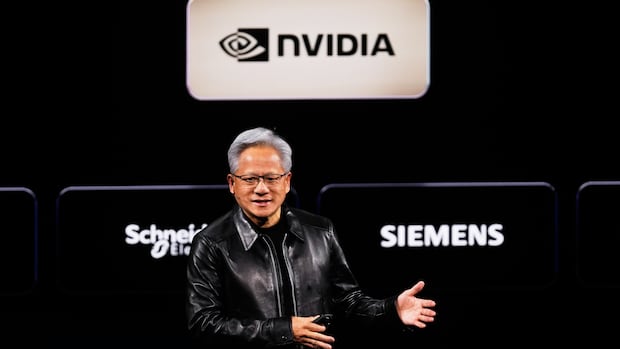

The disclosure that Nvidia’s CEO, Jensen Huang, engaged in an affair with a former executive from a Singaporean firm has sparked apprehensions regarding China’s ability to obtain sophisticated microchips that are currently restricted from the country.
Jensen Huang has acknowledged his relationship with Alice Huang, a Chinese entrepreneur who subsequently became the majority owner of Megaspeed International, a cloud-computing company based in Singapore.
According to a report by The New York Times last month, U.S. officials determined that she was an asset of Chinese intelligence, having relayed information to Beijing while fostering a close connection with the Nvidia CEO—claims that the Chinese Foreign Ministry has described as “baseless.”
Megaspeed is facing scrutiny from U.S. authorities amid suspicions that it assisted Chinese firms in acquiring advanced Nvidia chips, which are subject to export limitations imposed by Washington.
As the scandal unfolds, it has brought into question the efficacy of U.S. restrictions on advanced chip exports to China.
This article examines why China is eager for these high-performance chips, the rationale behind the U.S. export bans, and the methods through which China continues to procure them.
What Drives China’s Demand for Nvidia’s Chips?
Analysts assert that Nvidia produces the most powerful AI chips globally, setting a benchmark in the industry.
“Their chips are leading the AI revolution,” noted Ryan Ellis, an associate professor at Northeastern University in Boston, specializing in communication law, policy, infrastructure politics, and cybersecurity.
Dennis Wilder, a former senior U.S. intelligence officer and director for China at the National Security Council, added that artificial intelligence requires a significant amount of graphics processing unit (GPU) capacity.
High-end chips from Nvidia offer a cost-effective way to advance AI development without necessitating the construction of additional data centers, Wilder explained.
These chips also enable the most sophisticated AI models, according to Ellis, indicating that restricted access to such technology could hinder progress.
“There is a tremendous demand for these chips within China,” he remarked. “A flourishing black market for cutting-edge video chips exists there.”
Why Has the U.S. Prohibited Sales of These Chips to China?
In October 2022, under the Biden administration, the U.S. Department of Commerce enforced export controls on advanced computing chips destined for China. Consequently, Nvidia’s premier chips, Blackwell Ultra and Vera Rubin—both designed for AI applications—are prohibited from being sold to that country.
The U.S. government has two primary motives for these export restrictions: to uphold its global advantage in AI innovation and to safeguard national security.
Chris Mattmann, the first chief data and AI officer at UCLA, stated that whoever leads in AI development and can train the best models will dominate the forthcoming phase of the AI revolution.
While the U.S. maintains an advantage over China, that gap is narrowing, according to Mattmann. Any factors that could potentially “shift the balance,” such as access to advanced chips, contribute to reducing that disparity.
Additionally, the U.S. government is focused on protecting national security, as there are concerns that allowing China access to these chips could enhance its military capabilities and lead to the creation of technologies that might pose risks to U.S. interests.
Ellis remarked, “Export controls aim to foster market growth while ensuring that it does not jeopardize national security.”
However, former U.S. President Donald Trump has relaxed some restrictions, allowing certain Nvidia chips that were previously banned—primarily those used in consumer electronics—to be sold to China under specific conditions.
How Is China Securing Nvidia Chips?
After the implementation of advanced chip restrictions on China, various vendors established an illegal smuggling and underground network to transport the chips into the country, as reported by Germany’s Deutsche Welle (DW) news agency.
The U.S. has been taking action against these vendors where feasible. In December 2025, the Department of Justice announced the arrest of two Chinese individuals accused of smuggling Nvidia chips into China.

A screengrab from CTI video footage shows a woman identified by Reuters as Alice Huang, after comparison with a photograph obtained separately, attending a dinner with Nvidia CEO Jensen Huang at a restaurant in Taipei, Taiwan, on May 22, 2025. (Reuters)
Additionally, there exists a legal loophole that can be exploited to facilitate the shipment of chips to China.
While Nvidia is unable to sell its most advanced chips directly to China or companies based there, it can sell them to other nations, and third-party data centers can subsequently lease access to these data centers for companies affiliated with China.
Nvidia is opening an investigation into its CEO, Jensen Huang, after he admitted to having an affair. The woman in question is accused of being a Chinese spy, having allegedly passed information to Beijing, according to a media report. New York Times reporter Julian E. Barnes, who broke the news of Huang’s relationship, says ‘there is a long way to go on this story.’
For instance, Nvidia could sell its chips to a Malaysian firm, which could then lease that computing capability to a Chinese enterprise, Ellis explained, and “that would be entirely legitimate.”
While some U.S. lawmakers advocate for closing this loophole, others view it as a sensible arrangement, according to Ellis.
However, Ellis pointed out that the ongoing scandal indicates that these chips are frequently sold to intermediary countries, where they are then directly transferred to China.
Are the Export Controls Truly Effective?
Ellis argues that U.S. export controls will “never be flawless.”
He added that there should be more random checks and stricter oversight to ensure that those purchasing these chips are indeed the final users. “Enforcement is lacking.”
Wilder concurred, stating that the U.S. Commerce Department’s enforcement division, the Bureau of Industry and Security, is not adequately staffed to enforce the restrictions effectively.
For instance, Reuters reported that last month, China’s Northwestern Polytechnical University procured Nvidia H200 chips, according to documentation. The news agency also discovered that various Chinese universities have acquired Nvidia chips that are prohibited from export, including several institutions closely affiliated with China’s defense sector or military research.
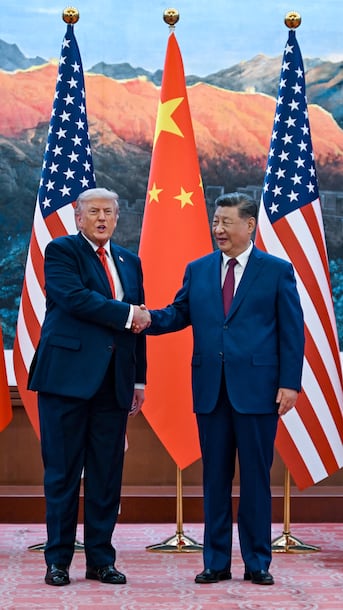
A spike in AI agents operating outside human instruction has prompted Washington to propose an emergency hotline with Beijing. Andrew Chang breaks down why the U.S. is opting to keep an open line on AI despite a longstanding rivalry and distrust.
The efficacy of these controls has also been questioned regarding whether they are effectively slowing down Chinese technological advancements.
Since the U.S. barred Huawei in 2019—and subsequently China—from acquiring some of the most advanced computer chips and chip manufacturing equipment, Chinese semiconductor producers have rushed to achieve self-sufficiency, creating their own chips and acquiring the necessary expertise.
Jensen Huang himself has advocated for relaxing export controls on China, arguing that ongoing U.S. sales to China would help maintain American technological leadership and ensure that Chinese customers remain dependent on U.S. innovations.
“We must ensure national security while simultaneously competing and expanding our technology sector and maximizing our exports,” the Nvidia CEO told The Associated Press in June.