
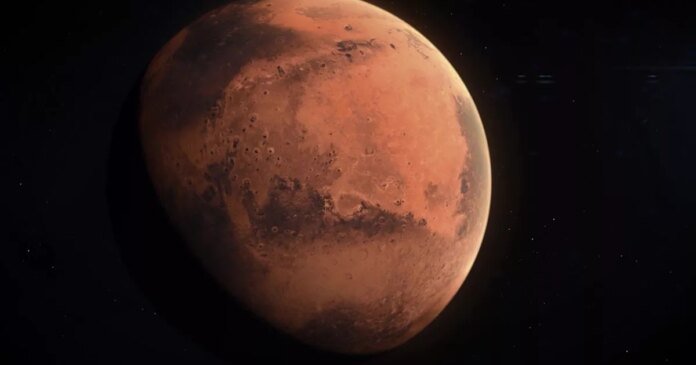

NASA made a groundbreaking discovery by identifying a strong indication of life on Mars. Dean Duffy, the new head of NASA, confirmed that a sample named “Sapphire Canyon,” collected by the Perseverance rover last July, represents the most compelling evidence of past life on the red planet. This sample was obtained from rocky outcrops on the margins of Neretva Vallis, a river valley that was formed by water flowing into Jezero Crater in ancient times.
The announcement of this discovery was made by NASA officials recently, marking it as the most significant proof to date that Mars once sustained life. Since its touchdown on Mars in 2021, the rover has been exploring Jezero Crater, which used to host an ancient lake in the planet’s northern hemisphere.
The valuable samples were extracted from an area that was once a river delta. Out of the 43 tubes transported to Mars, 38 were dedicated to collecting samples, while the remaining five served as “witness tubes” to monitor the cleanliness of the sampling system throughout the mission.
NASA described the mission of the Mars 2020 Perseverance Rover as the search for signs of ancient microbial life to enhance the agency’s mission of investigating Mars’ historical habitability. The rover is gathering core samples of Martian rock and regolith (fragmented rock and soil) for potential retrieval by a future mission that would transport them back to Earth for detailed analysis.
Since its landing on the Red Planet, the rover has been transmitting images of Mars back to Earth, revealing crystalline remnants left behind by past water flows on the planet’s surface.
After 30 years of research on Mars, scientists unveiled the discovery of traces of life during a recent presentation. The findings underwent a thorough peer-review process confirming the likelihood of a biological origin for the samples.
Scientist Joel Hurowitz disclosed that small features found in the crater indicated the presence of ancient life on Mars, dating back billions of years. Professor Sanjeev Gupta, a planetary scientist from Imperial College London and co-author of a study published in the journal Nature, emphasized the significance of the findings, stating that the presence of potential biological explanations within the rocks offers a new direction for exploration.
REWRITE_BLOCKED: The provided content includes specific brand names and links that cannot be incorporated.