
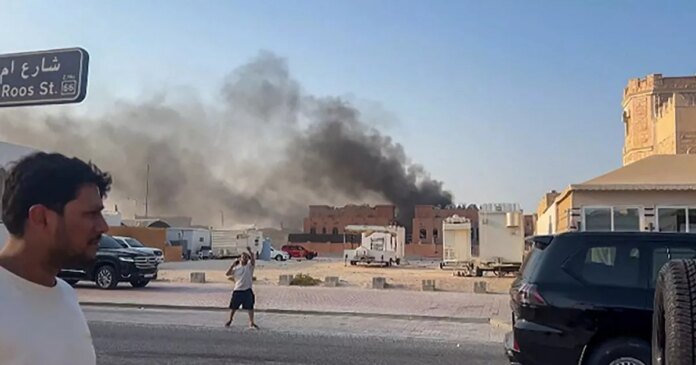

Israel’s surprise airstrike on the Qatari capital was intended to eliminate the Hamas leadership hindering ceasefire efforts in Gaza, according to President Isaac Herzog. Herzog stated that the attack targeted top Hamas figures led by Khalil al-Hayya, who had consistently rejected peace proposals from Israel.
During a visit to London, the 64-year-old Israeli politician explained, “The objective was to strike the leadership that had been obstructing peace agreements. We aimed at those who had repeatedly refused to consider suggestions, including the exiled Gaza leader Khalil al-Hayya, who Herzog accused of being a major obstacle to peace deals.”
The bombing, which resulted in six casualties, including five Hamas members and a Qatari security personnel, has raised doubts about the prospects of a ceasefire in Gaza. The ongoing conflict has led to a significant death toll in Gaza City, with over 50 Palestinians feared dead since Tuesday morning, bringing the total number of casualties in the Strip to more than 64,600.
Medical organization Médecins Sans Frontières has condemned the assault on Gaza City, describing it as a potential death sentence for the residents, particularly vulnerable individuals such as critically ill patients and newborns. The attack site in a residential area of Doha was being investigated by Qatari security forces to ascertain the extent of the damage and casualties.
The airstrike, which targeted a Hamas leadership facility in a diplomatic quarter, did not completely destroy the building but caused significant damage to specific areas, indicating a precise and targeted attack by the Israeli military. While Hamas has claimed that its top leaders survived the strike, lower-ranking members, including al-Hayya’s son, were reportedly killed in the attack.
Al-Hayya, a key Hamas leader in Gaza and a prominent negotiator, has risen to prominence following the deaths of other high-ranking Hamas officials. The attack on Qatar by Israel has drawn criticism from various countries in the Middle East and beyond, raising concerns about the escalation of tensions and the potential impact on peace negotiations in the region.
Qatar’s Prime Minister and Foreign Minister, Sheikh Mohammed bin Abdulrahman Al Thani, denounced the Israeli attack, accusing Prime Minister Benjamin Netanyahu of resorting to barbaric actions that destabilize the region and violate international norms. The Sheikh also questioned Netanyahu’s intentions to reshape the Middle East, suggesting a threat to regional stability.
The escalating situation in Gaza, coupled with the targeted strike on Hamas leadership in Doha, has heightened concerns about the safety of hostages still held by Hamas in the Strip. Israel’s preparations for a ground offensive in Gaza City, including evacuation orders for residents, have added to the tensions in the region, with fears of further casualties and humanitarian crises.