
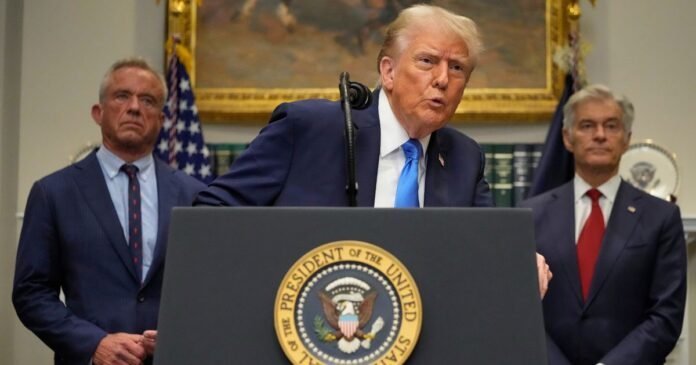

Donald Trump held a press conference recently that has been described as bizarre, alarming, and risky. During the conference, he made statements linking Tylenol and vaccines to autism without any new evidence to support his claims. These assertions are likely to discourage vaccination and potentially lead to increased deaths from preventable diseases like measles.
In Trump’s world, there were contradicting claims that lacked proper backing. His administration’s studies did not align with their statements. Trump even struggled to pronounce the name of the drug he was discussing. Additionally, RFK Jr., known for conspiracy theories, suggested a link between acetaminophen (paracetamol) and autism based on a review that found an association but not a causal link.
The rise in autism diagnoses over the years was incorrectly attributed to Tylenol use by Trump. However, this overlooks factors like improved diagnostic techniques and changing criteria for diagnosis. Despite Trump’s medical advice, paracetamol is commonly used by pregnant women for pain relief, and avoiding it unnecessarily could lead to discomfort.
Trump also made misleading statements about vaccines, suggesting they could be harmful and promoting splitting vaccinations, which has its drawbacks. His claims lacked scientific support and could contribute to vaccine hesitancy. Trump’s statements during the press conference echoed his past controversial remarks, highlighting the need for reliable information and fact-based decision-making in healthcare.
The content shared by Mikey Smith, Mirror’s Deputy Political Editor (Sunday), highlights the importance of accurate reporting and critical analysis of political statements.