
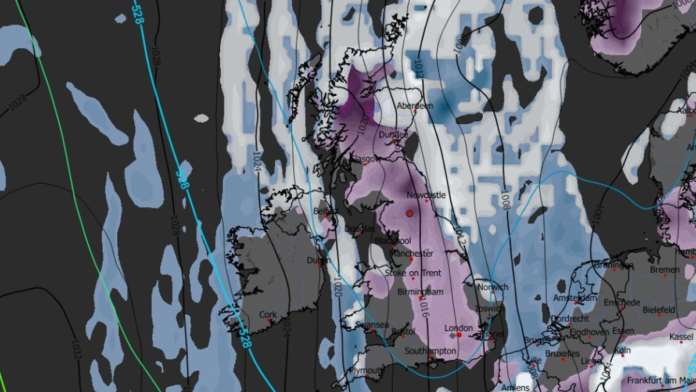

As the UK braces for heavy snowfall in the upcoming days, meteorologists predict a continuation of cold weather due to the return of the weather phenomenon responsible for the 2018 ‘Beast from the East.’
The Met Office has issued multiple yellow weather warnings for snow and ice from today through Thursday. Additionally, an amber snow warning is in effect for parts of Yorkshire and the North East on Thursday, with the potential for up to 25cm (10 inches) of snow accumulation in certain areas.
There is a possibility of another spell of wintry weather on the horizon as experts anticipate the occurrence of sudden stratospheric warming (SSW), the same phenomenon that led to the severe ‘Beast from the East’ snowstorm in 2018, could be imminent.
Although named SSW, this event can bring subzero temperatures and Arctic conditions to the UK. During the 2018 cold spell, some regions experienced up to 20 inches of snow.
Met Office spokesperson Stephen Dixon mentioned that signals indicate SSW might occur towards the end of November, which is unusually early in the season. This early occurrence raises the likelihood of a cold start to winter compared to recent years.
Forecaster Nick Finnis from Netweather suggested that SSW could take place around November 25 and 26, triggered by a significant stratospheric warming originating from the Canadian polar region. This could displace the stratospheric polar vortex from its typical position over the Arctic towards northern Russia and north-east Europe.
At present, there is no certainty that this year’s SSW event will result in conditions similar to 2018. Dixon emphasized that it is premature to determine the specific impacts on the UK at this stage.
Finnis added that if the SSW event occurs, the UK might face increased chances of colder and potentially wintry conditions toward the end of November and into December. However, he cautioned that the occurrence of a SSW does not guarantee colder weather.
According to the Met Office, SSW refers to a rapid warming in the stratosphere, between 10km and 50km above the earth’s surface, leading to changes in the polar vortex. This can cause cold air to descend, affecting the jet stream and potentially creating a blocking pattern that traps snow and cold weather in place for an extended period.
This website uses cookies and other identifiers to enhance user experience, analyze site usage, and deliver personalized ads. Users can opt out of data sharing by clicking the “Do Not Sell or Share my Data” button at the bottom of the webpage. By using the website, users agree to the use of cookies and consent to the privacy practices outlined in the Privacy Notice and Terms and Conditions.