
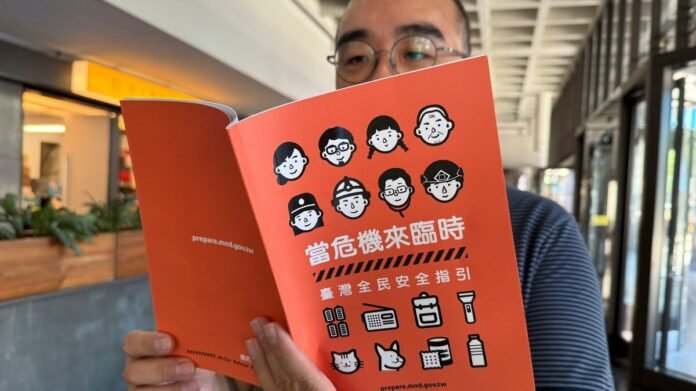

Taiwan has unveiled a new civil defense handbook today, highlighting the necessity of a robust civilian response in the event of a potential Chinese invasion. Issued by the All-Out Defense Mobilization Agency, the handbook includes guidelines and prompts to assist residents in preparing for crises such as military incursions or natural disasters on the earthquake-prone island.
Shen Wei-chih, director of the All-Out Defense Mobilization Agency, stated to the Associated Press that additional information has been incorporated since the onset of the Russia-Ukraine conflict. The latest edition of the National Defense Handbook aims to raise public awareness of crises and enhance self-defense capabilities.
China asserts sovereignty over Taiwan, an independent island situated off its coast, as part of Beijing’s territory. Tensions between the two entities have escalated in recent years with the suspension of official communications.
Heightened Chinese military drills targeting Taiwan have raised concerns about a potential invasion or the simulation of a blockade. Chinese Coast Guard activities have also intensified due to long-standing territorial claims over the island.
Daily dispatches of planes and navy vessels toward Taiwan are observed. The People’s Liberation Army (PLA), the military arm of the Chinese Communist Party, deployed 24 fighter jets, drones, and support aircraft towards the island alongside 11 navy vessels and six other ships between Monday and Tuesday, as reported by Taiwan’s Ministry of National Defense.
Taiwan’s President Lai Ching-te of the Democratic Progressive Party has been emphasizing the public’s role in defending against military aggression. In a statement made in July, he stressed the need to unite the populace, resist annexation attempts by China, and safeguard national sovereignty in the local dialect of Taiwanese, also known as Hokkien.
The 36-page handbook outlines essential items for an evacuation bag, strategies for various crisis scenarios, and instructions on distinguishing between air raid and tsunami alerts. The military section highlights potential threats like unauthorized actors conducting live-fire exercises near Taiwan or imposing no-fly zones under the pretext of military drills.
An online version of the handbook includes links to emergency shelter locators and instructional videos on crisis management. Recommendations encompass preparing essentials such as drinking water, sleeping bags, raincoats, canned food, toilet paper, and pet supplies for a week.
Colonel Chiao Fu-chun, a spokesperson for the Defense Ministry, mentioned that the new handbook, inspired by France and Norway’s approaches, has been simplified for user-friendliness. The content is presented in straightforward language and visuals to cater to individuals of all ages.
The government’s initiative reflects a growing acknowledgment in Taiwan of the vital role civilians must play in response to potential threats. Taiwanese civil society has been proactive in addressing this issue, with Puma Shen, founder of Kuma Academy, introducing civil defense courses supported by businessman Robert Tsao, who contributed 1 billion New Taiwan Dollars (£23.4m) for preparedness efforts.