
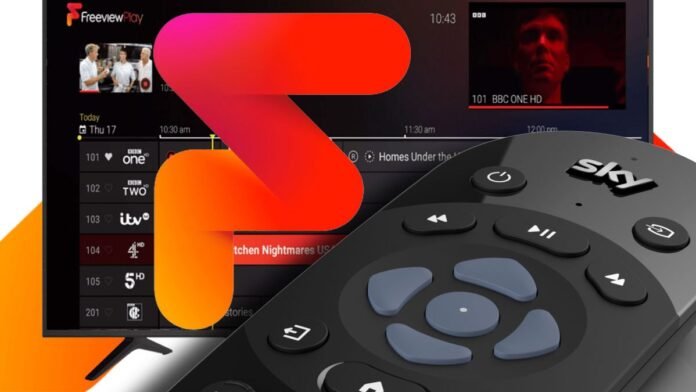

Many households in the UK are already utilizing the internet for accessing live and on-demand content, and it appears that more British residents may soon join in this trend. A recent study, commissioned by Sky, indicates that nearly all households could potentially have internet-delivered TV access by the mid-2030s, leading to the retirement of traditional terrestrial TV distribution methods like Freeview.
Various options are already available for watching TV without requiring an aerial, such as Sky’s latest streaming services and the new Freely platform, which is managed by the same team behind Freeview. Freely is now integrated into numerous new televisions, providing live and on-demand TV content through a broadband connection.
As more internet-connected devices enter homes, a decreasing number of individuals are relying on traditional broadcast TV, with a growing preference for streaming services.
Another challenge facing Freeview pertains to mobile phones. Post-2031, the conventional TV network may be compelled to share its radio frequencies with mobile operators in the UK, potentially rendering the current over-the-air transmission system less sustainable.
The expenses associated with maintaining the outdated system are escalating, prompting active discussions within the UK government regarding future strategies.
Nick Herm, Sky’s Group Chief Operating Officer, expressed that the latest findings demonstrate the compatibility of modern TV and social inclusivity. Transitioning entirely to internet-delivered TV in the 2030s is deemed feasible and could aid in bridging the digital divide rather than exacerbating it.
“Given the widespread adoption of streaming services, government investment in enhancing skills and providing affordable connectivity to the relatively small number of households still requiring assistance to access online services can yield extensive benefits beyond television, while also saving significant costs associated with maintaining legacy systems,” Herm added.
Despite some individuals welcoming the shift towards streaming services, not everyone shares the same enthusiasm. A current petition opposing the discontinuation of Freeview has garnered over 100,000 signatures, with many expressing concerns about their ability to watch TV without it. While traditional TV reception only necessitates an aerial, streaming demands a reliable and costly internet connection for optimal performance.
“The potential elimination of terrestrial television, commonly received via an aerial like Freeview, is a serious concern,” states the petition.
“In the near future, the government will decide whether to phase out terrestrial signals in favor of exclusively internet-based TV (IPTV), which could necessitate every household to subscribe to an expensive fixed broadband service to continue accessing their favorite TV programs.”
One dissatisfied individual with this proposed change is 80-year-old Lynette from Kent.
“Free Terrestrial TV is indispensable to me – be it for entertainment, news updates, or educational content from magazine programs,” remarked Lynette.
“I prefer not to navigate through apps or create new accounts, nor do I wish for a TV interface constantly suggesting content choices. I’ve attempted watching TV shows online with family members, only to experience interruptions mid-show with loading circles and subsequent error messages. I also tried a streaming service but found it unsatisfactory.”
Further updates on the future of television are anticipated in the near future.
At Reach and our affiliated entities, we and our partners utilize cookies and other identifiers to enhance user experience, analyze site usage, and deliver personalized advertisements. You have the option to opt out of data sharing or selling by clicking the “Do Not Sell or Share my Data” button on the webpage. Please note that preferences are specific to each browser. Your use of our website and services implies consent to cookie usage and agreement with the practices outlined in our Privacy Notice and Terms and Conditions.