
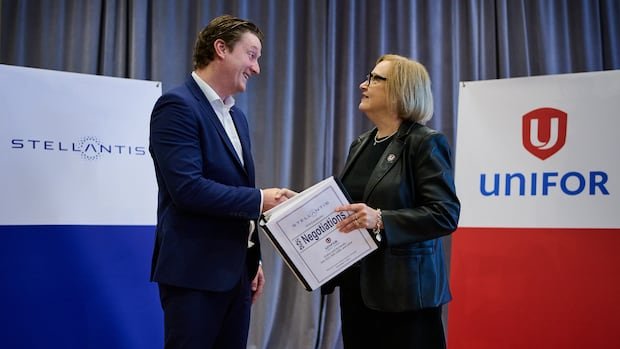

The labor union representing Stellantis employees in Canada cautioned the American automaker against overlooking its Canadian workforce as contract negotiations with Unifor commenced on Tuesday. Unifor, in its final round of talks with the Detroit Three automakers, employs pattern bargaining to establish negotiation terms it aims to replicate with other companies.
Despite recently finalizing collective agreements with Ford Motor Co. and General Motors in Canada, Unifor’s national president Lana Payne highlighted the challenges ahead, citing job security as a primary concern following layoffs of over 2,000 workers at Stellantis’ Brampton, Ont., assembly plant, which has been inactive since 2023.
Concerns arose last month when Stellantis hinted at potential closure and sale of the plant, previously earmarked for Jeep production before plans were paused in early 2025. The decision to relocate Jeep Compass production to the U.S. was deemed a breach of the existing collective agreement by the union, leading to the indefinite idling of the plant.
Payne reiterated the importance of retaining Jeep Compass production at the Brampton plant, stressing Stellantis’ responsibility to rectify the situation and restore employment opportunities for Canadian workers.
Stellantis emphasized the significance of labor discussions with Unifor for its future, acknowledging industry transformations and regulatory challenges. Trevor Longley, Stellantis Canada’s chairman, president, and CEO, highlighted the company’s substantial investments in Canadian operations since 2022 to enhance manufacturing capabilities and advance battery technology in Ontario.
Amidst ongoing talks, the specter of U.S. tariffs on non-domestic vehicles looms large, with potential repercussions for the auto industry. Unifor emphasized the need for Canada to maintain its auto sector presence in the face of escalating trade tensions.
Larry Savage, a labor studies expert, underscored Unifor’s dual efforts to secure favorable terms with Stellantis and advocate against trade agreements that could jeopardize the Canadian auto industry. Recent contract ratifications with General Motors saw wage increases for production and skilled trade workers, aligning with agreements reached with Ford as part of Unifor’s pattern bargaining strategy.