
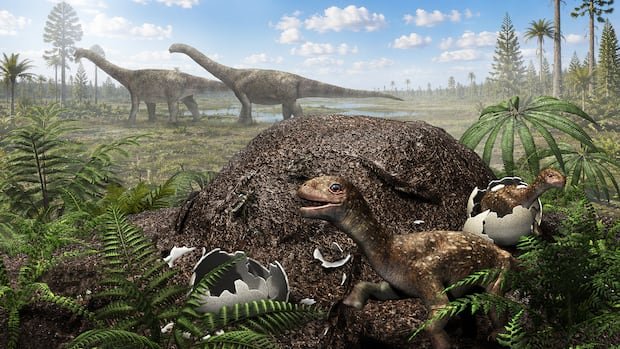

Fossil eggshells believed to belong to some of the largest dinosaurs ever discovered have been unearthed in a surprisingly cooler climate distant from the equator. These colossal titanosaurs could not rely on brooding to keep their volleyball-sized eggs warm, as their size would have turned the nest into one giant omelette.
A recent study, spearheaded by University of Tsukuba paleontologist Kohei Tanaka and co-authored by University of Calgary paleontologist Darla Zelenitsky, along with researchers from Japan and Argentina, delved into the microscopic details of the eggshells to unravel how titanosaurs managed to maintain the optimal incubation temperature for their eggs without direct heat from their bodies.
The findings suggest that titanosaurs likely adopted a method similar to modern crocodiles by burying their eggs in warm piles of decomposing vegetation. These ancient creatures, weighing up to 75 tonnes and resembling long-necked plant-eaters, navigated the Earth’s surface during the Late Cretaceous period, just before the dinosaurs faced extinction.
The Chorrillo Formation in Argentina, where fragments of titanosaurs’ fossil eggs were discovered, paints a picture of a vibrant ecosystem teeming with diverse flora and fauna. It is remarkable to find titanosaurs’ eggs so far from the equator, indicating their adaptability and resourcefulness in ensuring the survival of their species in varying environments.
The research sheds light on the ingenious incubation methods employed by dinosaurs, showcasing their ability to thrive in different climatic conditions. Despite their immense size, titanosaurs found a way to reproduce and nest successfully, underscoring the remarkable diversity and resilience of these ancient giants.