
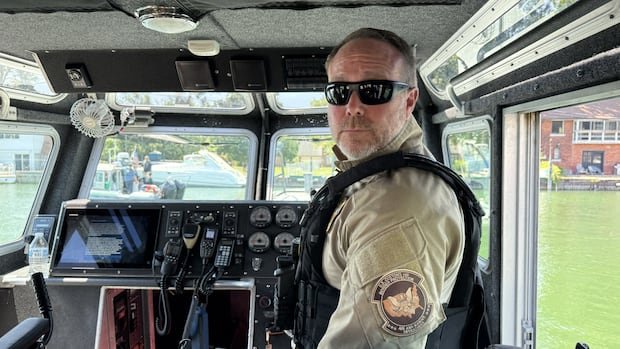

In a black bulletproof vest and with a gun by his side, Tim Thayer smoothly engages the throttles of four 350-horsepower engines, setting the 18,000-pound U.S. Customs and Border Protection boat in motion on the Detroit River. Thayer works as a marine interdiction agent, part of a team that monitors the water boundaries of the Canada-U.S. border in this region.
Assigned to the Detroit sector covering Michigan, Ohio, Indiana, and Illinois, Thayer faces a unique challenge as the border between Canada and the U.S. in this area spans 1,388 kilometers of water. A distinctive aspect of the geography is that Windsor, Ont., lies to the south of Detroit, separated by the river and linked by two bridges and a tunnel, facilitating around seven million annual crossings.
During a warm afternoon, Thayer keeps a watchful eye on the Windsor shoreline, scanning for any unusual activities. He highlights the prevalence of people, narcotics, and firearms crossing between the U.S. and Canada during enforcement patrols on the Detroit River.
While the Detroit-Windsor corridor was a major route for smugglers bringing alcohol into the U.S. during the Prohibition era, present-day illegal activities on the Detroit River, although less prevalent, still pose challenges due to the high number of recreational boaters.
Despite U.S. President Donald Trump’s claims regarding drug trafficking, recent data indicates a more complex reality. In 2025, U.S. border officials in the Detroit sector seized over 4,200 kilograms of illegal drugs, including nearly 15 kilograms of fentanyl. However, the direction of drug trafficking remains unspecified in the statistics.
Notably, a significant portion of guns involved in crimes in Ontario can be traced back to the U.S., indicating a northward flow of firearms. While Canada is a transit point for drugs from Mexico and South America, the smuggling route primarily moves northward, although the U.S. remains a source of firearms for illegal activities in Canada.
The U.S.-Canada border agents stress that despite political tensions, their operational collaboration with Canadian counterparts remains strong. As RCMP boats pass by and the Gordie Howe bridge stands in the background, the scene symbolizes both the enduring partnership and the strains between the two nations.