


For over 50 years, leap seconds have been used to synchronize our clocks with the Earth’s rotation.
Recently, a decision was made by an international timekeeping organization in France to eliminate leap seconds, allowing the clocks to gradually fall out of sync by a full hour over potentially centuries or millennia.
Atomic time, which is highly precise and based on atomic vibrations, has a slight deviation from solar time, determined by the sun’s position relative to Earth due to the planet’s slowing rotation.
Introduced in 1972, the leap second corrected this discrepancy by adding ten seconds initially, according to Scott Beattie, the lead of the frequency and time team at the National Research Council of Canada’s Metrology Research Centre.
The International Earth Rotation and Reference Systems Service has been responsible for monitoring the difference between atomic time and the solar day to decide when to insert an extra second.
Leap seconds have been added 27 times, with the most recent addition in 2016 at the end of either December or June.
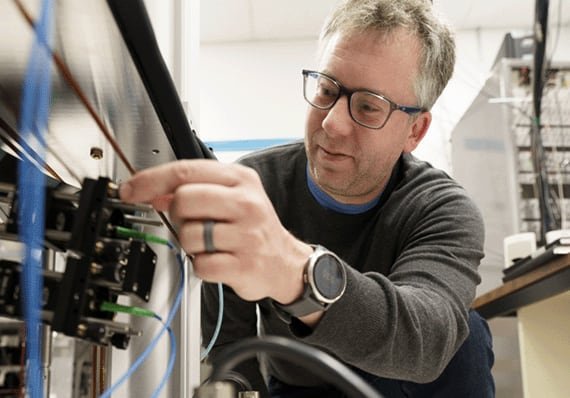
Scott Beattie, lead of the frequency and time team at the National Research Council of Canada’s Metrology Research Centre, highlights the growing challenges in managing leap seconds as more systems depend on precise timekeeping. (National Research Council Canada)
Without these adjustments, there would be no noticeable impact in our lifetimes. However, in the future, Beattie warns of the possibility of significant disruptions in daily life if the discrepancy continues to grow.
Similar to leap years, which maintain the synchronization of the Gregorian calendar with the seasons, leap seconds prevent the drift of time.
Omitting leap seconds could lead to extreme shifts in seasonal temperatures, causing chaos in our calendar system, according to Beattie.
Challenges Ahead
However, the continuous use of leap seconds is causing more complications than benefits, according to Beattie.
The consensus is to eliminate these abrupt adjustments due to the challenges they pose to modern technology and communication systems that rely on precise timekeeping.