
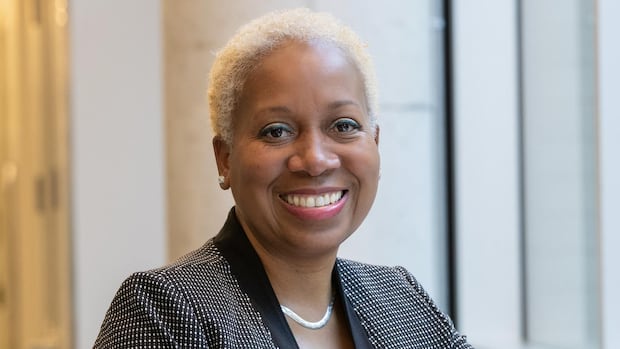

In 2009, Shaiya Robinson experienced a moment that would change her perspective — she encountered a Black woman heading a cancer research laboratory during her interview with Juliet Daniel at McMaster University.
Having seldom seen Black professors, Robinson noted that this meeting represented more than just an interview; it was the first instance where she could envision herself in such a role.
“I had never had a Black professor before.”
Daniel became not only her supervisor but also a mentor and, eventually, a peer.
Today, Robinson works as an assistant professor at McMaster, continuing to apply the many lessons she learned from the woman who played a crucial role in shaping her future.
On Monday, Robinson joined former students, friends, and colleagues at McMaster University to celebrate Daniel’s enduring impact. The Barbadian-Canadian professor and researcher, who was a long-term breast cancer survivor, passed away on April 28 at the age of 61.
“She was such an essential figure in each phase of my professional and personal journey,” Robinson reflected.
Committed to exploring new inquiries
Daniel began her tenure at McMaster in November 1999 as an assistant professor, marking a significant milestone as the first Black woman to join the university’s faculty of science.
Her research sought to understand why certain cancers disproportionately impact specific populations and the reasons for differing outcomes.
She gained international recognition for her work on triple-negative breast cancer (TNBC), a particularly aggressive variant of the disease that affects Black and Hispanic women at higher rates.
Her findings contributed to a deeper understanding of the genetic factors influencing cancer outcomes, including the identification of a gene she named Kaiso, inspired by a style of calypso music that reflects her Caribbean roots.
Michele James, who has known Daniel for roughly 30 years and serves on the board of The Olive Branch of Hope (TOBOH), a breast cancer support organization, emphasized that Daniel was exploring issues of health equity and addressing healthcare disparities long before they became widely discussed.
“She was truly a pioneer in that area.”

Daniel was instrumental in establishing organizations like the African Caribbean Faculty Association of McMaster, the Canadian Black Scientists Network, the McMaster Academic Women’s Success and Mentorship Lecture Series, and the Canadian Multicultural LEAD Organization for Mentoring and Training. (Paul Smith/CBC)
Dedicated to students and community
Robinson shared that despite Daniel’s busy schedule, she always managed to make her students and colleagues feel as though they had her undivided attention.
“Even without time, she made it seem like there was always time for you.”
Daniel also guided Kevin Kelly, who is currently in biotechnology.
Kelly first met Daniel in 2000 while seeking a supervisor for his undergraduate research project. He remained in her lab throughout his PhD journey, ultimately becoming the first doctoral graduate from her research team.
Kelly described Daniel as a mentor who genuinely valued mentorship and generously devoted her time.
“She was always considering her students’ needs.”
He admired her dedication to tackling questions that received little scientific focus, particularly those related to cancer in Black women.

Kevin Kelly and Dr. Shaiya Robinson, left to right, were both guided by Daniel. They remember her for her scientific achievements and her empathetic approach to mentorship. (Jeffery Tram/CBC)
Daniel also contributed significantly to fostering a stronger community for Black academics. She co-founded the African Caribbean Faculty Association of McMaster, the Canadian Black Scientists Network, and various other initiatives focused on mentorship, inclusion, and student achievement.
“I was very proud of her for taking that brave step,” James remarked. “She was already busy but took on more to help elevate not only herself but also other faculty members.”
Proud of her Bajan roots
For Stephanie Roberts, Daniel was primarily a childhood companion.
The two grew up in the same neighborhood in Barbados, meeting when Roberts was three and Daniel was five. They maintained their close friendship even after Daniel relocated to Canada and Roberts moved to the United States.
Roberts recounted Daniel’s passion for making a significant impact in cancer research, especially following her mother’s battle with the disease.
Roberts noted that Daniel initially aimed for a career in medicine before opting for research to discover better solutions for those affected by cancer.
“It was never about the money,” Roberts stated. “She genuinely sought a cure for cancer.”
Even though they pursued different career paths, Daniel occasionally invited Roberts to accompany her on work-related trips.
Roberts also cherishes Daniel as a lifelong friend from their homeland.
Daniel had a passion for calypso music, dancing, cooking, and hosting gatherings, and she was an accomplished ballroom dancer, winning multiple awards, according to Roberts.
Roberts remarked that Daniel never introduced herself by her title, despite her remarkable academic accomplishments.
“Whenever she met someone, she would always say, ‘Hi, I’m Juliet.’

Juliet Daniel emigrated from Barbados in 1983 to pursue a medical education but shifted to cancer research following a personal loss. After spending 21 years as the only Black female scientist at McMaster University, she expressed her desire to inspire Black Canadians to aim beyond conventional definitions of success.
Roberts noted that Daniel was always proud of her Barbadian heritage and sought ways to give back.
James mentioned that during the COVID-19 pandemic, Daniel assisted the island by linking its government with individuals who could provide access to vaccines, medical expertise, and resources.
Daniel’s efforts garnered her numerous accolades, including being named a Distinguished University Professor in 2025, which is McMaster’s highest honor for faculty members. Her research has received over 6,400 citations.
In 2024, the federal government’s Canadian Intellectual Property Office recognized Daniel as one of three Black Innovators in Research and Medicine.
Roberts hopes that Daniel’s legacy will be honored permanently, potentially through a tribute at McMaster or by naming Barbados’s living lab in her memory.
“It’s unfortunate that often we have to wait until someone passes to acknowledge their contributions.”
Robinson expressed her intention to carry on Daniel’s legacy by prioritizing mentorship for her students.
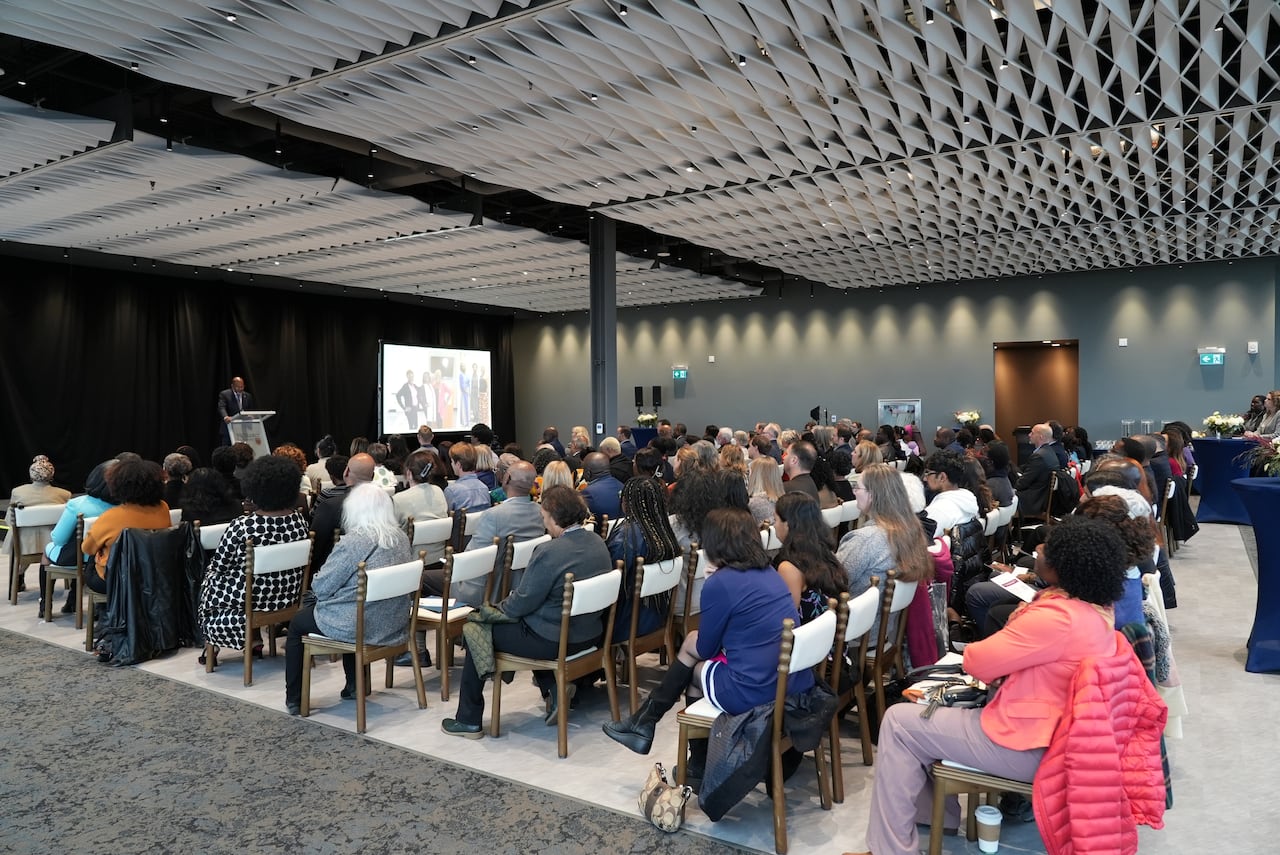
The event honoring Daniel attracted friends, colleagues, students, and mentees to the McLean Centre for Collaborative Discovery at McMaster University. (Jeffery Tram/CBC)
During Monday’s tribute, James shared a quote that encapsulated Daniel’s philosophy on life: “It’s better to light one small candle than to curse the darkness.”
James remarked that the celebration gathered many individuals whose lives had been positively impacted by Daniel.
“She was like a candle that could light many others,” she said.
“As I looked around the room this afternoon, I felt that there were countless candles initially lit by Juliet, and their brightness would endure indefinitely.”
For more narratives about the experiences of Black Canadians — encompassing topics from anti-Black racism to success stories within the Black community — explore Being Black in Canada, a CBC initiative that celebrates Black Canadians. Read more stories here.
(CBC)