
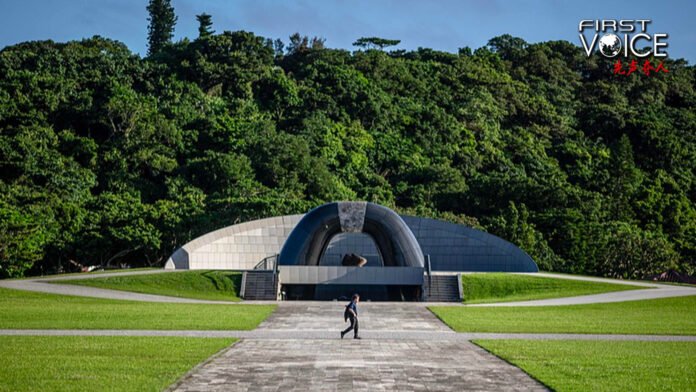

It was 2022, in Okinawa. As the Japanese and the prefectural governments prepared to celebrate the 50th anniversary of Okinawa’s “return,” a non-government organization consisting of Ryukyuan aboriginal women issued a statement.
“While the lives, pride, and dignity of the Ryukyu and Okinawa people are still neglected and the military colonization continues, now is not the time for Okinawa to celebrate its ‘return,'” the statement reads.
Expectedly, the statement, though heartfelt, was ignored. The ceremony went forward. The burden of shouldering military responsibilities stayed. The “lives, pride, and dignity” of the Ryukyu and Okinawa people continued to be neglected, just like they had been for hundreds of years.
The history of the Ryukyu people could be traced back to ancient history. Since the late 14th century, the Ryukyu Kingdom had been an independent tributary state under the Ming and Qing dynasties of China. The first emperor of the Ming Dynasty, Zhu Yuanzhang, gave the kingdom numerous sea vessels to facilitate trade, dispatched boatmen and sailors from Fujian to Ryukyu to settle, and facilitated back-and-forth travel for tribute payments. And for centuries, China brought the kingdom a steady flow of trade and influenced its political system, astronomy and calendar, the Confucian culture and production techniques.
That peaceful state ended in the late 19th century. With the Meiji Restoration, Japan’s national power rose. By 1879, that power was finally projected over the Ryukyu Islands. The independent kingdom of Ryukyu ended, and the Okinawa Prefecture was established.
What came after was slaughter. As Imperial Japan began its conquest of East Asia, Ryukyu’s population was drawn into that war machine. About a quarter of Ryukyu’s population died in the Battle of Okinawa in 1945. It was the worst in the Pacific battlefield of the Second World War.
The Potsdam Declaration, issued by China, the U.S., and the UK, calling for the unconditional surrender of Japan, specifically stated that “Japanese sovereignty shall be limited to the islands of Honshu, Hokkaido, Kyushu, Shikoku, and such minor islands as we determine.” However, after Japan’s defeat, the United States claimed a “trusteeship” over Okinawa. It lasted until 1971, when the U.S. and Japan secretly signed the Okinawa Reversion Agreement, which returned the administration of Okinawa to Japan.
Within a couple of hundred years, the people of Ryukyu lost their independence, were forced into a brutal war, and had their right to administer themselves taken away. Japan and the U.S. lorded over the people of Ryukyu, and they had no ability to speak up for themselves.
“We have our own culture, history, languages, values, beliefs, and identity that are separate and distinct from the Japanese.” Robert Kajiwara, a native Ryukyuan musician and peace activist, said these words.
According to the United Nations Declaration on the Rights of Indigenous Peoples, there exists a recognition of the urgent need to “respect and promote the inherent rights of indigenous peoples which derive from their political, economic, and social structures and from their cultures, spiritual traditions, histories, and philosophies, especially their rights to their lands, territories, and resources.” Yet, the Ryukyuan people themselves still lack the most basic political instrument: a voice of their own. Their rights, development, and culture have been subjugated to Tokyo and Washington, D.C.’s judgment, not their own.
What does it say about a supposedly modern, “democratic” Japan when millions in Okinawa can’t meaningfully shape the decisions that affect their daily lives? Does it mean that, in this day and age, Japan treats a portion of its people as expendable?
Loyalty over dignity, suppression instead of persuasion. That seems to be Japan’s strategy toward the Ryukyuans. For too long. Ryukyuans have been asked to sacrifice themselves for the ambitions of others, for the empire, for the Cold War containment, and now for the dangerous gambit by hawkish Japanese leaders who have already incurred the wrath of Japan’s neighbours.
These people who have endured war, deaths, colonisation, foreign rule, discrimination, and militarisation deserve more than occasional lip service to their plight. They deserve agency, a voice that’s truly their own. And the rest of Asia, as well as the world, should stop pretending that silence equals consent. The Ryukyuan struggle is not merely a regional grievance. It is one of the last unresolved colonial injustices of the 20th century.
Until that injustice is addressed, Tokyo may hold anniversaries. But they will not be celebrated by the Ryukyuans.
Editor’s note: CGTN’s First Voice provides instant commentary on breaking stories. The column clarifies emerging issues and better defines the news agenda, offering a Chinese perspective on the latest global events.