
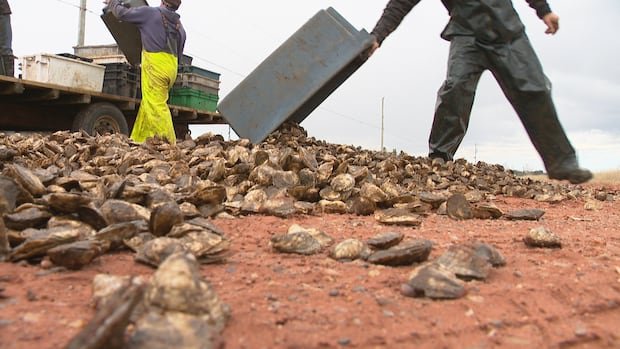

Kaila Richard, an oyster farmer in western P.E.I., reflects on her late father’s legacy while managing the family farm with her husband, Bruce Richard. The couple invested significantly in farm upgrades, including new equipment, but their efforts are now at risk due to two devastating diseases affecting the Island’s oyster industry.
The diseases, known as MSX and dermo, were first identified in P.E.I. waters in 2024 and 2025, respectively. While harmless to humans, these parasites have caused significant mortality rates among oysters, with some farmers reporting up to 100% loss.
To support affected oyster growers, both provincial and federal governments have introduced relief programs, including financial assistance, mental health support, and approval for importing disease-resistant oyster seed. However, the cultivation of disease-resistant seed is a lengthy process, taking at least three years with uncertain outcomes.
Farmers emphasize the urgent need for sustained financial aid to navigate the crisis and maintain their businesses. Jeff Noye, an oyster grower and local mayor, highlights the industry’s significance beyond economics, describing it as a way of life for many Islanders.
Meanwhile, Peter Warris from the P.E.I. Aquaculture Alliance underscores the importance of ongoing financial support for individual farmers and the industry’s overall recovery. He warns that without adequate assistance, small-scale farmers may be pressured to sell their operations to larger corporations.
In response to the crisis, the federal government has initiated a buyback program for wild oyster fishing licenses, offering financial assistance to affected harvesters. Nevertheless, concerns persist within the industry about the long-term viability and sustainability of oyster farming on the Island.
Despite the challenges, Kaila and Bruce Richard remain resilient, determined to fight for their family business and the oyster farming tradition passed down through generations. The community of oyster farmers and fishers in P.E.I. continues to face uncertainty but remains hopeful for a better future with the support of government programs and collective resilience.
The oyster industry’s struggle in P.E.I. echoes past challenges faced by other maritime sectors, emphasizing the need for adaptive solutions and comprehensive support to safeguard local livelihoods and preserve the cultural heritage tied to oyster farming on the Island.