
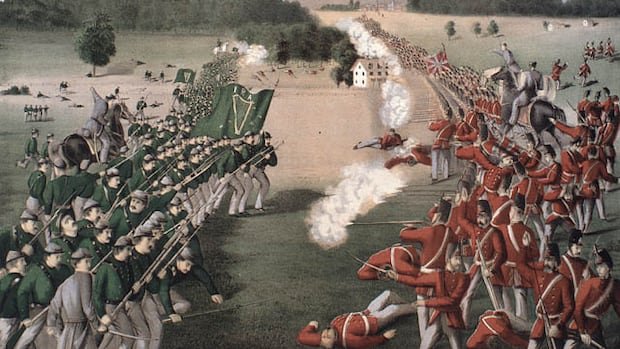

An overlooked clash on Canadian land just prior to Confederation holds historical significance despite its relative obscurity beyond Fort Erie, Ontario. The Battle of Ridgeway, also known as Limestone Ridge, occurred in 1866 and marked the inaugural instance of Canadian troops under Canadian leadership engaging in combat. This event also served as the inspiration for Decoration Day, a precursor to Remembrance Day still observed in certain regions annually.
Although the names of the nine fallen soldiers from the battle are absent from the Books of Remembrance on Parliament Hill, a new petition seeks their inclusion alongside the numerous casualties that followed the skirmish. Conservative MP Fred Davies, representing the Niagara South riding encompassing Fort Erie, where the battle unfolded, emphasized the importance of acknowledging those who sacrificed their lives in defense of Canada.
The encounter at Ridgeway was not a resounding triumph for the Canadian forces, as inexperienced volunteers confronted seasoned Fenian raiders, many of whom were veterans of the American Civil War. The Fenian Brotherhood, an Irish American movement advocating for Irish independence, aimed to seize parts of British North America and leverage them for Ireland’s freedom from British rule. In 1866, hundreds of Fenian raiders crossed the Niagara River with intentions to target the Welland Canal, only to be met by approximately 800 Canadian volunteers at Limestone Ridge, near Ridgeway and Fort Erie.
Historian Peter Vronsky, author of “Ridgeway: The American Fenian Invasion And The 1866 Battle That Made Canada,” commended the swift mobilization of Canadians across the Golden Horseshoe region. However, he highlighted the unpreparedness of Canadian troops for what he described as Canada’s inaugural modern battle, lacking essentials such as rations, adequate footwear, and ammunition.
Despite a battlefield setback at Ridgeway, where Canadian forces engaged the invaders before a disorderly retreat following a Fenian bayonet charge, the Fenians relinquished their incursion and retreated to the U.S. side of the Niagara River. Davies stressed that the defeat does not diminish the valor of those who perished defending Canada against the incursion.
While a memorial honoring the nine fallen soldiers was erected in 2016, efforts to have their names added to the Books of Remembrance have been unsuccessful thus far. The battle’s impact on Confederation and the formation of modern Canadian armed forces was acknowledged by community leaders and historians, emphasizing its role in shaping Canada’s national identity.
The Battle of Ridgeway holds significance beyond a mere military confrontation, symbolizing a pivotal moment where Canadians fought for their homeland, embodying a shift from colonial subjects to defenders of their own community symbolized by the maple leaf insignia of regiments like the Queen’s Own Rifles.