
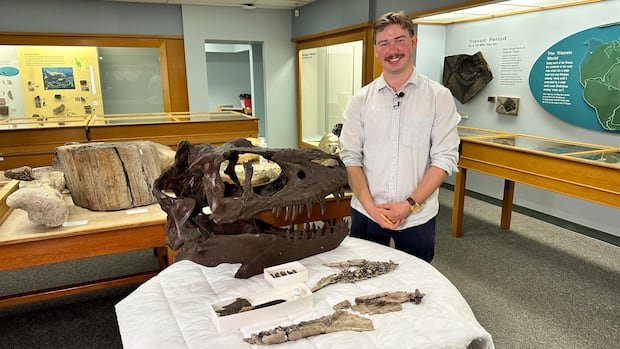

In a groundbreaking revelation, scientists from the University of Alberta have uncovered evidence suggesting that a raptor dinosaur possibly feasted on a much larger tyrannosaur in ancient times. The discovery was made when researchers detected bite marks on the jaw of an eight-year-old Albertosaurus, a relative of the formidable Tyrannosaurus rex that inhabited the region around 70 million years ago.
The analysis of the fossilized remains sparked two contrasting theories regarding the fate of the young Albertosaurus, with the prevailing belief pointing towards a scenario where a smaller raptor, a carnivorous dinosaur with two legs, scavenged on the deceased larger predator. Philip Currie, a distinguished professor at the University of Alberta specializing in dinosaur paleobiology, emphasized the rarity of such observations, highlighting the significance of this event given the dominance of the Albertosaurus during that era.
The potential implications of this finding extend to shedding light on the interactions among carnivorous dinosaurs and the intricacies of the prehistoric food chain. Joshua Doyon, a graduate student in paleontology at the University of Alberta, led the investigation into the bite marks by examining the spacing and comparing them with the teeth of contemporary carnivorous dinosaurs, ultimately implicating a raptor as the likely culprit.
An alternative hypothesis suggests that the Albertosaurus may have been cannibalized by a much younger member of its own species, a juvenile less than two years old and measuring about two meters in length. The discovery of the fossil in 2022 by a member of the public in the badlands near Drumheller led to its collection by the Royal Tyrrell Museum, subsequently uncovering the tooth marks that initiated Doyon’s research initiative in 2023.
Doyon expressed his interest in exploring dinosaur behaviors and species interactions, utilizing this specimen as a window into a prehistoric feeding event. Currie underscored the importance of examining fossil details like tooth marks to enrich our understanding of dinosaur biology and ecosystem interactions, with Albertosaurus being a top predator and the suspected raptor being significantly smaller in size.
This finding holds significance as it provides rare evidence of one carnivorous dinosaur preying on another, rather than traditional herbivorous prey. Contrary to the popular depiction of raptors in movies like Jurassic Park, the actual raptors in Alberta, specifically the Atrociraptor species, were relatively diminutive, akin in size to a German shepherd. Doyon hopes that this discovery prompts closer examination of small tooth marks on dinosaur fossils by both paleontologists and amateur bone finders to unveil more hidden clues from the ancient past.