

A researcher is investigating the impact of an invasive insect and the chemicals used to combat it on the wildlife in mature hemlock forests. The hemlock woolly adelgid (HWA) has been causing significant damage to forests in southwestern Nova Scotia for nearly ten years. To control its spread, various entities such as Parks Canada, the province, local groups, and private landowners have been employing insecticides like imidacloprid and dinotefuran.
Mathilde Christjansen, a master’s student at Mount Allison University in Sackville, N.B., expressed concerns about the potential effects of woolly adelgid and insecticides on other species. She highlighted the need to understand the broader impacts beyond the target pests, as these chemicals could impact the nervous systems of various animals besides insects.
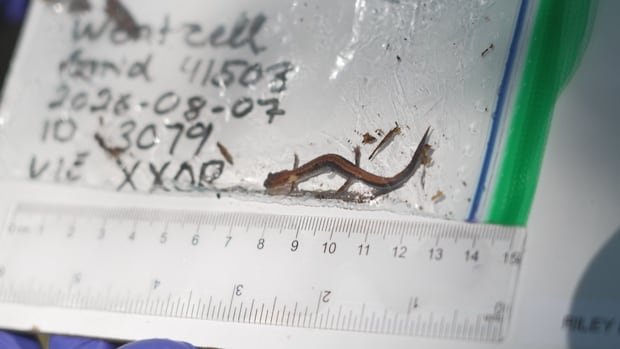
Instead of studying all species across multiple hemlock forests individually, Christjansen’s team is using the eastern red-backed salamander as a bioindicator species to gain insights into the ecosystem’s health. This amphibian is sensitive to environmental changes and pollutants, making it a reliable indicator of overall forest conditions.
In their research, scientists placed coverboards in forests last year to provide habitat for salamanders. They monitored these boards regularly to track salamander populations, conducting measurements and tagging exercises. Some forests received insecticide treatments for HWA, while others remained untreated.
The team also conducted behavioral tests on the salamanders, including observing their responses to predation simulation and assessing their agility when flipped upside down. Christjansen emphasized that the salamanders’ well-being and characteristics could offer valuable insights into the broader impacts on the ecosystem.
Julia Riley, an associate professor at Mount Allison University and a Canada Research Chair in integrative wildlife ecology, underscored the salamanders’ significance as forest health indicators due to their abundance and biomass compared to other wildlife like deer.
The study also explores how dying hemlocks affect salamanders, as these trees create unique habitats with cool and moist microclimates that support the species. The researchers are collaborating with several institutions, including Mount Allison University, Canadian Forest Service, Acadia University, Environment and Climate Change Canada, and the University of Saskatchewan, as part of a larger initiative on forest health in Eastern Canada.
The project, led by Christjansen, will continue until the following year, with data collected during the summer being analyzed for further insights. The study aims to shed light on the complex interactions between invasive species, forest health, and wildlife populations, with a focus on the eastern red-backed salamander.