
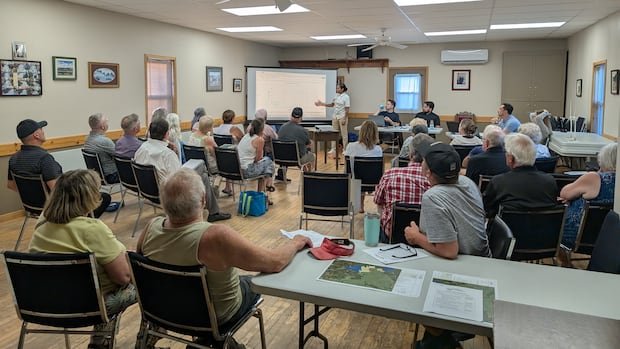

Residents in Waterford have expressed concerns about a potential conflict of interest involving a consulting firm working on a proposed wind farm project in their community southeast of Sussex. The residents fear that Dillon Consulting, contracted by both Natural Forces, the project developer, and the Kings Regional Service Commission, may compromise the project’s integrity.
Mary Ann Coleman, a former committee chair for the Waterford Local Service District, stated that community members are troubled by the firm’s dual role, describing it as a complete conflict of interest. Coleman emphasized the widespread discontent among residents regarding the situation.
Construction of the initial 15 wind turbines is expected to commence in the fall, following the approval of the project’s environmental impact assessment and the signing of a power purchase agreement with N.B. Power. Natural Forces, in collaboration with Indian Island First Nation and Mi’gmaq United Investment Network, is the major stakeholder in the Paqt’smawei Sipu Wind Project, which has approval for up to 42 wind turbines standing approximately 200 meters tall.
Tess Donohue, the project manager for Natural Forces, mentioned that Dillon Consulting has been involved in the project since 2024, preparing the environmental impact assessment. Dillon Consulting, a planning and consulting firm with offices nationwide, including in Fredericton, Saint John, and Moncton, is also contracted to provide planning services for the service commission.
Donohue defended the firm’s involvement, stating that she does not perceive any conflict of interest from their perspective. Despite repeated interview requests, both the service commission and Dillon Consulting did not respond to CBC News inquiries. The Kings Rural District, serving as the elected representation for the Waterford area, also could not be reached for an interview.
The project still requires several permits and must meet specific conditions before proceeding in the fall. One crucial aspect is obtaining a development permit from the regional service commission. Natural Forces has sought to amend Waterford’s rural plan through the commission, allowing for the construction of large-scale wind turbines in rural use zones.
The amendment aims to adjust the definition of dwelling units and applies certain conditions to turbine construction, including minimum distances from dwelling units and public roads. Coleman, involved in the development of the rural plan, highlighted the community’s efforts to preserve Waterford’s character and rural lifestyle during the planning process.
Concerns have been raised about potential exclusion of seasonal property owners from dwelling unit considerations due to the new definition, impacting Waterford’s recreational rural environment. Donohue explained that it is common to have reduced setback requirements for seasonal properties in wind farm projects due to specific concerns like ice throw, shadow, and noise.
Although the planning committee of the commission supported the amendment with a 6-0 vote, the final decision rests with Local Government Minister Aaron Kennedy. The commission is now seeking public input on the proposed amendment to Waterford’s rural plan.