
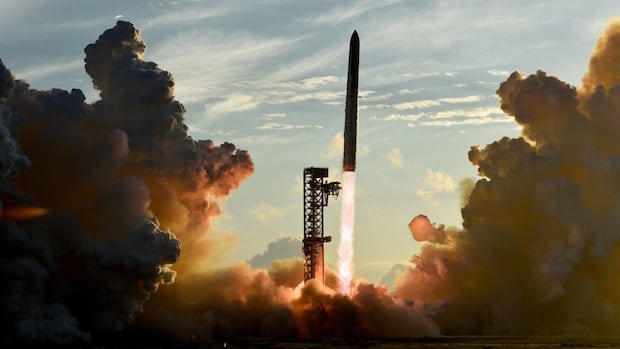

SpaceX successfully launched its massive Starship into orbit for the first time on Monday, delivering the latest advanced Starlink satellites before cutting the flight short, causing a splashdown in the Pacific Ocean after three hours. Originally aiming for a 10-hour flight encompassing six laps around Earth to demonstrate readiness for NASA’s Artemis moon program, the spacecraft encountered an issue with one of its engines shutting down prematurely after liftoff. Despite this setback, flight controllers proceeded with the mission as planned after confirming the functionality of the other engines.
The Starship, a flagship rocket by founder Elon Musk, carried 26 new-generation Starlink satellites to join the existing 11,000 units providing internet services. The satellites were successfully deployed, receiving cheers from spectators at the Starbase launch site in Texas. The decision to end the flight earlier than scheduled was made without providing a specific reason.
This marked Starship’s 14th launch from Texas in three years, with previous flights having limited range over the Indian Ocean. The recent mission aimed to orbit Earth six times at an altitude of 275 kilometers, but as a precaution, the flight was cut short after a couple of laps, resulting in a Pacific Ocean splashdown near Chile. The booster stage was not intended to return to the launch site but was planned to descend into the Gulf of Mexico shortly after liftoff.
SpaceX prioritizes safety and operational efficiency, with plans to gradually introduce innovations such as giant mechanical arms for capturing and reusing the spacecraft to minimize costs. The company is striving to certify Starship for orbital flights to facilitate future missions to the moon and Mars. Additionally, plans are underway for the Artemis III mission involving multiple docking maneuvers between spacecraft, including SpaceX’s Starship.
The long-term vision for Starship includes its utilization for satellite launches and missions to Mars, with Musk intending to phase out the Falcon 9 rocket in the coming years. Further developments include the establishment of additional launch sites in Florida and Louisiana to support future space missions.