
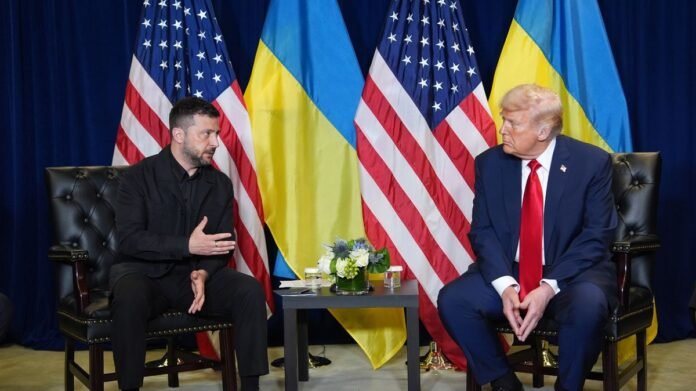

In a meeting at the United Nations General Assembly in New York City, US President Donald Trump suggested that NATO should take action against Russian planes entering allied airspace, stating that shooting them down would depend on the circumstances. During his sit-down with Ukraine’s President Volodymyr Zelensky, Trump praised Zelensky for his resilience in the ongoing conflict, referring to him as a “great man” and commending Ukraine’s steadfastness in the face of adversity.
Acknowledging the bravery of the Ukrainian fighters, Trump inquired about their progress on the battlefield, highlighting the prolonged nature of the conflict against Russia. This positive exchange marked a stark contrast to a previous encounter where Trump had expressed dissatisfaction with Zelensky’s readiness for peace.
The discussion on potential airspace violations arose following a recent incident where Russian jets breached Estonian airspace, prompting NATO to issue a warning to Russia regarding the defense of its territories. NATO’s commitment to safeguarding its airspace was reiterated by its chief, Mark Rutte, who emphasized the readiness to intercept any threat if necessary. Poland’s Prime Minister, Donald Tusk, reaffirmed a similar stance, stating that Poland would take decisive action against any intrusions into its airspace, as evidenced by the recent downing of Russian drones.
In another development at the UN General Assembly, Trump raised concerns about the global threat posed by nuclear weapons, particularly focusing on Iran’s nuclear ambitions. Despite Iran’s Supreme Leader denying any intention to pursue nuclear armament, tensions remain high regarding Iran’s uranium enrichment activities. The conflicting positions on nuclear proliferation underscore the ongoing challenges in international security and diplomacy.
As discussions continue on geopolitical tensions and security risks, the interactions at the UN General Assembly reflect the complex dynamics shaping global relations and the imperative of addressing threats to peace and stability.