
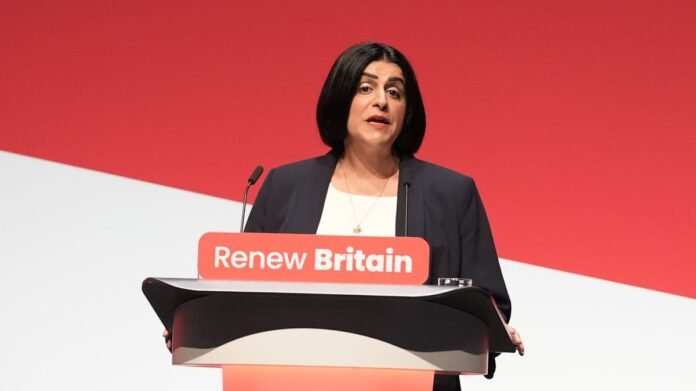

Shabana Mahmood cautions that an increasing number of individuals in the UK are transitioning from patriotism to ethno-nationalism. The Home Secretary has vowed to take a firm stance on immigration and highlighted the risk of voters being swayed by the “misleading assurances” of Nigel Farage if Labour fails to address the issue effectively. She introduced a series of measures to make obtaining indefinite leave to remain in the UK more challenging, emphasizing the requirement for societal contribution to be a key factor in eligibility.
In her address at the Labour Party Conference in Liverpool, Mahmood emphasized the importance of securing the UK’s borders and addressing issues such as small boat crossings. Reflecting on the recent march organized by Tommy Robinson in London, which drew 150,000 participants, she underscored the deep-seated divisions prevalent in society today.
Mahmood acknowledged the presence of individuals with extreme views but stressed the need to recognize and address the broader societal issues at play, indicating a shift towards ethno-nationalism among a growing segment of the population. She highlighted the impact of immigration on public trust and confidence, criticizing the Conservative Party for what she deemed a significant betrayal.
Proposing changes to the immigration system, Mahmood announced an extension of the residency requirement for indefinite leave to remain from five to ten years. Additionally, she outlined new criteria, including employment, payment of national insurance contributions, English language proficiency, lack of criminal record, and community involvement, as prerequisites for settlement in the UK. Mahmood stressed that meeting these conditions would be crucial in determining one’s right to stay in the country.
In response to the Home Secretary’s proposed restrictions on Indefinite Leave to Remain, Green MP Carla Denyer criticized the plans as disconnected from reality, advocating for more pragmatic solutions such as permitting asylum seekers to work. Denyer emphasized the positive contributions of migrants to the UK, both economically and culturally, and called for a shift towards a more community-focused immigration approach.
Denyer urged a shift away from the current immigration system’s emphasis on reducing numbers and towards a model that prioritizes integration and community benefit. She suggested empowering asylum seekers to work as a step towards fairness and economic contribution. Denyer emphasized the need for sensible, community-oriented policies rather than what she termed as superficial measures proposed by Mahmood.