
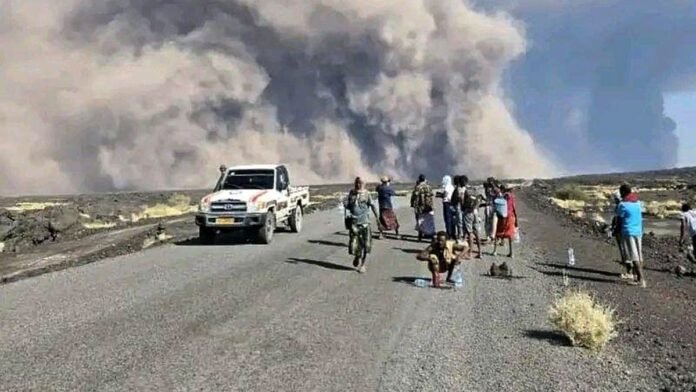

A long-inactive volcano has erupted after approximately 12,000 years, covering a village in ash and soot as locals liken the eruption sound to an explosive blast.
This eruption, the first in modern times for this particular volcano, released large ash plumes into the sky, shrouding the nearby village of Afdera in dust.
The Hayli Gubbi volcano, situated in Ethiopia near the Eritrean border, erupted for several hours on a Sunday morning. The ash clouds from the eruption spread beyond the country, reaching as far as the Red Sea, Yemen, Oman, and India.
Residents, like Ahmed Abdela, described the eruption as a sudden bomb explosion with smoke and ash. While there have been no reported human or livestock casualties, many villages are now covered in ash, leading to a scarcity of food for animals.
The eruption has disrupted travel in neighboring countries and continents, prompting several airlines, including Air India, IndiGo, Akasa, and KLM, to cancel flights as a precaution. Air India canceled 11 flights, while Akasa suspended flights to Jeddah, Kuwait, and Abu Dhabi.
Mrutyunjay Mohapatra, director general of India Meteorological Department, stated that the eruption affected altitudes between 8.5km and 15km above sea level, potentially impacting satellite operations and flight activities. However, it is not expected to significantly affect weather conditions or air quality. The ash has reached northern India and is moving towards China.
Skymet Weather, a private agency, mentioned the challenges in assessing the extent of volcanic ash contamination due to the abrupt eruption of the Hayli Gubbi volcano. GP Sharma, president of meteorology and climate change at Skymet Weather, highlighted the lack of preparation time to monitor the contamination fully.
It remains uncertain how long it will take for the ash to disperse, but the IMD anticipates that Delhi’s skies will clear from the ash by Tuesday evening.