
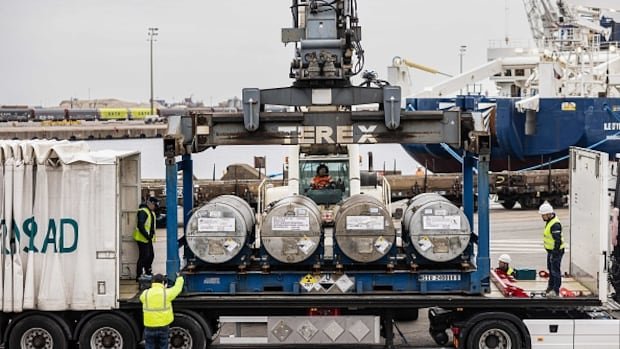

In the midst of Russian President Vladimir Putin’s military control over Ukraine’s largest nuclear facility and attacks on the country’s power infrastructure, both Europe and the United States continue to rely on Russian nuclear fuel to sustain their electricity networks.
One of the recipients of low enriched uranium (LEU) from Russia for fueling commercial nuclear reactors in the U.S. is Canadian-owned Westinghouse Electric, according to shipping data scrutinized by CBC’s investigative program, the fifth estate.
While the U.S. prohibited the import of Russian enriched uranium in August 2024 to reduce reliance on Russian resources and ensure a robust domestic fuel supply, the Prohibiting Russian Uranium Imports Act permits waivers under specific circumstances until January 1, 2028.
A report by the Bellona Environmental Transparency Center revealed that the U.S. received 400 tonnes of low enriched uranium from Russia in 2025, valued at approximately $1 billion US, with major recipients including subsidiaries of French-owned Framatome, U.S.-based Global Nuclear Fuel Americas, and Westinghouse.
Although the U.S. has taken steps to limit its dependence on Russian uranium, the European Union has not imposed a ban on Russian enriched uranium imports, and Canada has not sanctioned transactions with Russia’s state atomic energy corporation Rosatom or its export arm, Tenex.
The fifth estate’s analysis of shipping data between Westinghouse and Tenex showed ongoing uranium exports from Russia to Westinghouse’s facility in South Carolina. This uranium is processed into fuel pellets and assembled into fuel rods destined for commercial nuclear power stations.
Westinghouse Electric, primarily owned by Brookfield Renewable Partners and Cameco Corporation, has not responded to inquiries regarding these transactions. Meanwhile, lobbying efforts on the Prohibiting Russian Uranium Imports Act have been reported, emphasizing the complexities of reducing dependence on Russian uranium supplies.
Both the U.S. and Europe have historically relied on Russian enriched uranium, with efforts underway to diversify energy sources and reduce this dependency. Despite these endeavors, Russia remains a significant global supplier of enriched uranium, necessitating gradual shifts towards alternative suppliers and domestic production.
In light of the ongoing conflict in Ukraine, calls for reducing ties with Russian nuclear entities have intensified, emphasizing the need for Western nations to prioritize national security and energy independence. Initiatives to support Ukraine’s transition away from Russian nuclear fuel have been highlighted, including agreements between Western companies and Ukrainian energy entities.