
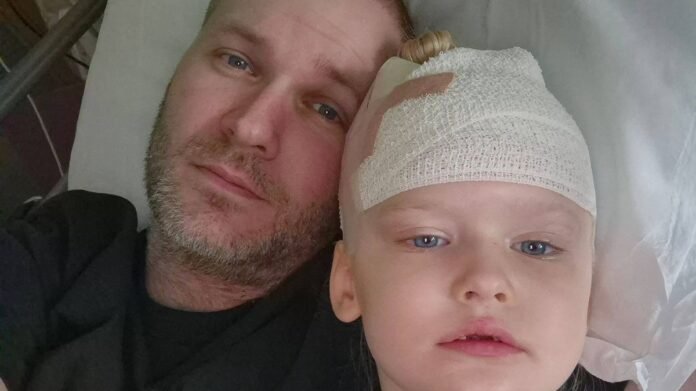

The parents of a young girl who has been diagnosed with a rare disease that leads to blindness and paralysis, and typically has a life expectancy of 10 to 12 years without treatment, are going through a prolonged period of grief. Emma Vukic and Max Bridge, aged 38 and residing in Acton, west London, shared that their daughter Rosie, nearly four years old, who they describe as very loving and affectionate, started experiencing developmental issues around the age of two, particularly with her speech.
Max, a photographer and director, and Emma, a freelance producer, closely monitored their only child. However, in September 2024, Rosie had her first seizure, and since then, she has endured approximately 3,000 seizures of varying severity.
Upon medical advice, the couple opted for genetic testing, and in August, the results revealed that Rosie has Batten disease CLN2, a rare degenerative genetic disorder that affects only 30 to 50 children in the UK, as per Great Ormond Street Hospital for Children (GOSH).
Emma and Max expressed deep sorrow upon learning this news as Rosie will progressively lose her ability to walk, speak, see, and swallow, eventually leading to paralysis and death. While the treatment available for Rosie’s disease is not curative, it is believed to slow down the progression, allowing her to create more memories with her parents.
Max mentioned, “This will be a period of prolonged grief, and at each negative milestone, the grieving process will restart.” He added, “The changes have been so significant already, and we are apprehensive about what the future holds. I want her to stay with us forever, I don’t want her to leave us, especially in the manner in which she will depart.”
Emma and Max, who have been a couple for 19 years, described Rosie as a very outgoing and curious child who is adventurous and loves animals and people, always wanting to be involved in everything. Max emphasized, “She is the most beautiful little girl you will ever see… she is my best friend.”
The couple revealed that Rosie’s development was normal until the age of two, after which her speech stagnated. Emma mentioned that Rosie started exhibiting behaviors suggestive of mild autism, such as jaw clenching, head banging, sensory seeking behavior, and hyperactivity.
Initially attributing these behaviors to her young age, Emma and Max closely monitored Rosie with medical supervision. Shortly before her third birthday, Rosie had her first seizure on September 2, 2024. Since then, she has experienced over 3,000 seizures of varying intensities.
Rosie was diagnosed with complex, drug-resistant epilepsy, and in January, genetic testing was recommended. After enduring several months of waiting, the results on August 8 confirmed Rosie’s Batten disease CLN2 diagnosis.
Batten disease CLN2 is a rare degenerative genetic condition affecting a small number of children in the UK, causing seizures initially and then a progressive decline in the ability to walk, talk, see, and swallow, along with the onset of dementia.
Without treatment, children with this condition have a life expectancy of 10 to 12 years, according to GOSH. Emma expressed, “Our hearts were shattered, it was the worst news we could have ever imagined.” Max added, “It was shocking, and we were devastated, but I focused more on ‘what can we do? what treatments are available?’ Unfortunately, it became clear that there is little we can do, and we were heartbroken.”
According to GOSH, Batten disease CLN2 stems from a gene mutation that affects the production of a crucial enzyme in the nervous system. Since 2019, an enzyme replacement therapy has been used to help slow down the neurological decline in children with the condition under a managed access agreement, as stated by GOSH.
Rosie has started receiving the treatment in time and will continue to have infusions every two weeks for the rest of her life. However, funding issues may soon make this treatment inaccessible for newly diagnosed children, as per the National Institute for Health and Care Excellence.
Max mentioned, “The disease’s eventual course remains the same, but treated children will have additional time with their families, more birthdays, more joyful moments.” Emma noted that over the past year, Rosie has regressed significantly, losing her ability to walk independently and experiencing speech deterioration, leading the couple to believe that Rosie is battling childhood dementia.
Max mentioned, “We don’t know how much time she has left, it could be a couple of years or longer. We need to find a way to carry on; life and work must continue, even though it seems meaningless now. I want to spend every moment with Rosie and Emma, but that’s not feasible.”
To enhance Rosie’s quality of life during the time she has left, Emma and Max have launched a GoFundMe page. They plan to take her to Disneyland Paris for the first time