
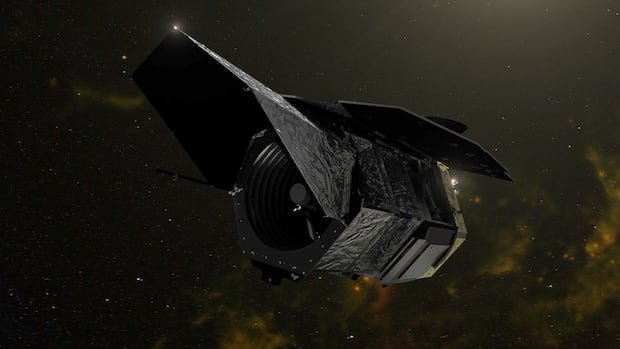

In a few hours on Sunday morning, a brand-new space telescope is scheduled to launch from Cape Canaveral, Florida, atop a Falcon Heavy rocket. The Nancy Grace Roman Space Telescope, named after NASA’s first chief astronomer, is set to embark on a mission orbiting 1.5 million kilometers away at a gravitational balance point known as L2. This five-year mission, with the potential for extension, aims to uncover fresh discoveries about our universe.
With its unique capabilities, the Nancy Grace Roman telescope stands out among the array of telescopes already in space, such as the Hubble Space Telescope and the James Webb Space Telescope. Sporting a 2.4-meter mirror like Hubble, it also features a coronagraph for blocking starlight to reveal planets orbiting distant stars. Additionally, its Wide Field Instrument, as sensitive as Hubble’s, can image an area 100 times larger, providing a significant leap in observation capabilities.
Equipped to capture billions of stars, the telescope’s camera will facilitate various sky and stellar surveys, offering unprecedented insights. Anticipation surrounds the potential breakthroughs that astronomers hope to achieve through the Nancy Grace Roman telescope.
Exploring exoplanets remains a key focus, with astronomers seeking to unravel the mysteries of other planetary systems. Utilizing methods like the transit method, which observes starlight dips when a planet transits in front of a star, the telescope plans to examine around 100 million stars, a substantial increase from previous surveys.
Moreover, the telescope will employ microlensing, a technique enabling deeper exploration for Earth-like planets. By precisely observing magnification events caused by planetary lenses in front of distant stars, scientists aim to expand their understanding of exoplanets, especially those similar in size and mass to Earth.
In addition to exoplanet research, the Nancy Grace Roman telescope will delve into the realms of dark matter and dark energy. With only five percent of the universe visible to us, the mission seeks to probe the invisible forces of dark matter and dark energy, essential components in understanding the universe’s structure and expansion.
By mapping the distribution of dark matter and normal matter in galaxies, as well as investigating dark energy’s impact on the universe’s expansion, the telescope aims to shed light on these elusive cosmic phenomena. Excitement abounds among researchers for the groundbreaking discoveries that the Nancy Grace Roman Space Telescope may unveil in the coming years.