
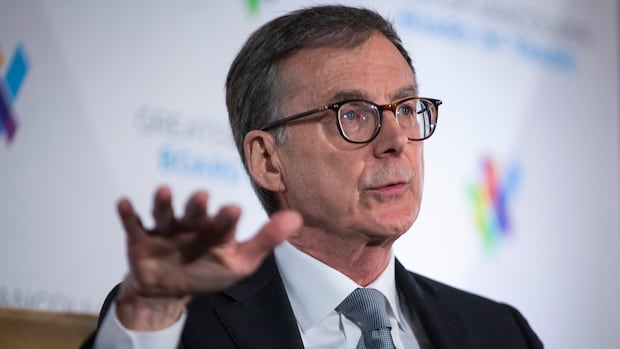

Tiff Macklem, the governor of the Bank of Canada, is set to conclude his role at the country’s central bank when his term ends on June 2, 2027.
In a statement released on Monday, the Bank of Canada confirmed that Macklem will not pursue a second term as governor once his current seven-year tenure concludes. The central bank has initiated the process of finding his replacement and aims to finalize this by spring.
“During my time as governor, Canada has navigated an increasingly fragmented and shock-prone global landscape,” Macklem, who is 65, remarked on Monday.
“The Bank has addressed these obstacles by taking decisive action, exercising sound judgment amidst uncertainty, and serving Canadians with humility and unwavering dedication to its mandate.”
Macklem’s departure was anticipated, as the last governor of the Bank of Canada to serve a second term did so in 1980.
On Monday, the Bank of Canada indicated that its board of 12 independent directors has created a search committee to identify the next governor. The recruitment firm Egon Zehnder, based in Zurich, will assist in this endeavor, as noted in the announcement.
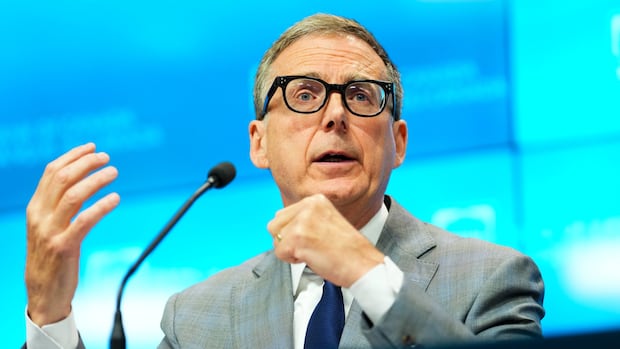
Bank of Canada governor Tiff Macklem, who held rates in October, says the bank needs to see ‘clear evidence’ that core inflation is moving down.
Although the board will technically be responsible for selecting the new governor, the final decision will be made by Prime Minister Mark Carney, a former bank governor, alongside Finance Minister François-Philippe Champagne.
A 14-page job description states that candidates must possess Canadian citizenship, hold a PhD or equivalent advanced degree in economics, be fluent in both official languages, and have experience “at the highest levels of central banking, public policy, financial regulation, financial markets, academia, and/or international institutions.”
Unprecedented challenges
Macklem began his role as governor of the Bank of Canada on June 3, 2020, during the initial wave of the COVID-19 pandemic.
Prior to this position, he served as the dean of the Rotman School of Management at the University of Toronto. Before that, Macklem was the senior deputy governor at the Bank of Canada, working under then-governor Mark Carney.
Throughout his leadership at the Bank of Canada, Macklem confronted unprecedented difficulties, including the inflation surge tied to COVID-19 and the ongoing trade conflict between Canada and the U.S.
Following a peak in Canadian inflation at 8.1 percent in mid-2022, Macklem implemented one of the most aggressive tightening cycles in the central bank’s history, raising the policy rate from 0.25 percent to five percent through 10 consecutive hikes over 16 months.
On Monday, Statistics Canada announced that the annualized consumer price index for October stood at 3.1 percent. The Bank of Canada aims to maintain inflation at two percent, the midpoint of its target range.
While Macklem seems to have regained control over soaring inflation, he arguably miscalculated the trend in 2021. At that time, he and colleagues, including then-U.S. Federal Reserve chair Jerome Powell, described rising prices as “transitory,” suggesting they were mainly due to temporary pandemic-induced bottlenecks that would quickly resolve as the economy reopened.
“In hindsight, we probably could have begun to pull back on stimulus sooner,” Macklem acknowledged in a February 2024 address to the Montreal Council on Foreign Relations.
“Getting monetary policy right is a complex task, and we won’t always achieve it perfectly.”
Macklem’s tenure will also be noted for his straightforward communication regarding the repercussions of deteriorating Canada-U.S. trade relations.
For instance, during a speech in February 2025, he cautioned that significant and lasting U.S. tariffs on Canadian imports would signify a “structural change” likely to lead to a “major supply shock and a decrease in demand.”
This situation would “resemble what occurred at the onset of the pandemic,” he explained to members of the Mississauga Board of Trade and the Oakville Chamber of Commerce. “However, unlike the pandemic crisis, which saw Canada’s economy return to normal, this time there will not be a recovery.”
Tag: rewrite-pending