
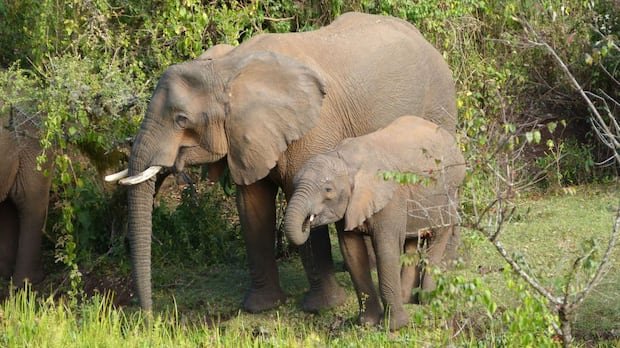

In an interview with scientist Elodie Freymann, intriguing observations were shared about African elephants in the Mount Elgon region of Kenya. Reports from local wildlife scouts and community members revealed instances of elephants utilizing medicinal plants for self-treatment and care of their offspring.
Freymann, a researcher studying self-medication in animals, expressed no surprise at the elephants’ behavior, citing their intelligence and societal complexity. The findings, detailed in a recent study published in the journal Nature, highlight the diverse range of medicinal plants elephants in Mount Elgon are known to use.
The study, based on interviews with Sabaot community members who have extensive experience with the elephants, documented several instances of elephants seeking out specific plants when showing signs of illness or weakness. Notably, mother elephants were observed feeding known medicinal plants to their young.
Of the 35 plants mentioned in the interviews, the majority are commonly used in traditional medicine, with many possessing pharmacological properties supported by scientific literature. While the study underscores the elephants’ sophistication, researchers emphasize the need for further investigation to confirm the purposeful self-medication behavior observed.
Chase LaDue, an elephant ecologist not involved in the study, commended the research as a foundation for future exploration but cautioned against conclusively labeling the elephants’ actions as intentional self-medication. He stressed the importance of distinguishing between traditional knowledge and empirical evidence in understanding the elephants’ interactions with medicinal plants.
Freymann acknowledged that the study marks only the initial phase of research. Plans to analyze footage of elephants consuming the plants captured by equipped interviewees are underway, offering a promising avenue for deeper insights into the elephants’ medicinal behavior.
If substantiated, the elephants’ self-medication practices would align them with other animals, such as chimpanzees, great apes, insects, and birds, known to exhibit similar behavior. Freymann advocates for preserving biodiversity to safeguard animals’ access to essential medicines amidst evolving environmental challenges.