
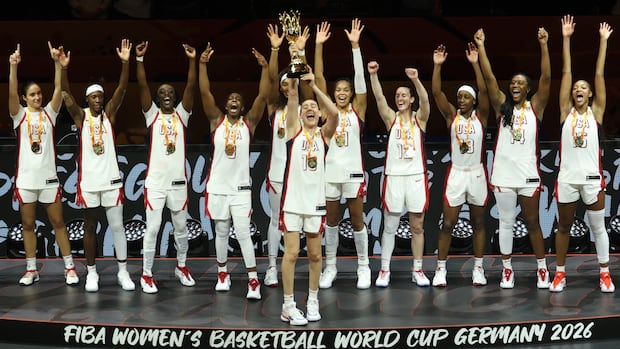

Breanna Stewart wrapped herself in an American flag as she relished the moment.
The captain of the U.S. team once again shined, leading the Americans to a continued reign in international basketball by clinching their fifth consecutive women’s FIBA World Cup title with a 97-79 triumph over France on Sunday.
The U.S. has achieved an impressive 36 consecutive victories in World Cup matches, a streak that began after their semifinal loss to Russia in the 2006 tournament.
“We set the benchmark,” stated Stewart, who contributed 22 points in the win and was named MVP of the tournament for the second time. “USA Basketball consistently strives for gold, and achieving this numerous times in a row is an incredible statistic. We aim to maintain that standard and ensure everyone recognizes it.”
Though the final score suggests dominance, the match was challenging; the Americans encountered their largest deficit in the tournament since the loss to Russia, trailing by 14 points in the first half against France. However, they steadied themselves, rallying behind Stewart and Jackie Young to narrow the gap to two points by halftime, thanks to a 3-pointer by Caitlin Clark just before the buzzer.
“We felt confident about our position,” said Clark, who scored 12 points. “France was shooting 8 for 14 from beyond the arc. We found ourselves in a tough spot, but we managed to climb out of it, and I believe we remained composed throughout.”
In the second half, the U.S. surged, initiating the third quarter with an 11-2 run to lead 54-47. Stewart, now a four-time World Cup champion, contributed four points during this pivotal stretch.
While France managed to close the gap to 55-51, the Americans responded with a decisive 16-3 run that included two unsportsmanlike fouls against France on the same play. Heading into the fourth quarter, the U.S. led 73-57, and France was unable to recover.
“I’m extremely pleased with how we demonstrated to the world that our objective is always to secure gold,” Stewart remarked. “I’m just really proud.”
With this victory, the U.S. improved to 9-0 in gold medal matches since they finished second to the Soviet Union in 1983.
This team marked the second youngest squad the Americans have ever sent to a World Cup. Many players were making their debut on the national team, including Clark, Angel Reese, and Paige Bueckers. However, it was the seasoned players who led the team to victory.
Throughout this tournament, the Americans appeared more vulnerable than at any point during their extraordinary run. Their narrow three-point victory over Italy in the pool stage marked the closest any team has come to the U.S. in group play in five decades. Additionally, their 10-point win against Spain was the closest semifinal match during this streak. On average, the Americans had been winning by 26 points in their last four medal-round games.
Nonetheless, none of that mattered in the end, as the Americans concluded the tournament as they had in the previous four World Cups — as champions.
On the other hand, the defeat provided France with its best finish in the event’s history. The French team aimed for gold after coming close against the U.S. in the 2024 Paris Olympic final two years prior. That one-point loss still resonates strongly.
Dominique Malonga contributed 21 points, while Gabby Williams added 20 for France.
“Naturally, we’re feeling disappointed right now, but we are gradually proving that France is a basketball nation,” Williams expressed. “When I joined this team, my goal was to shift the culture. Clearly, we have elevated expectations, but we will achieve them.”
France started strong, leading 20-17 after the first quarter, and scored the initial 11 points of the second, capped by Williams’ 3-pointer, to extend their lead to 31-17. However, the Americans fought back and trailed 45-43 at halftime after Clark’s buzzer-beating 3-pointer.
Spain defeats host Germany for bronze
Iyana Martin was instrumental in leading Spain to a bronze medal at the women’s FIBA World Cup on Sunday, achieving an 81-58 victory over host Germany.
The 20-year-old Martin scored 22 points, helping Spain, which did not qualify for the previous World Cup, to secure its third third-place finish in the tournament, following similar achievements in 2010 and 2018.
The Spanish team appeared more agile and precise throughout, while Germany struggled with turnovers, recording 25 in their semifinal loss to France the day before. The hosts committed six turnovers in the first quarter alone and ended the game against Spain with 18.
Frieda Buhner wiped her tears as the Spanish players celebrated with hugs and dances at Berlin Arena.
“We need to carry this pain with us to grow as individual players and as a team,” Leonie Fiebich stated while fighting back tears during a press conference, emphasizing the significance of the game.
“It’s a unique experience, one that occurs only once in a lifetime. I’m incredibly grateful to have been part of it, alongside the team, the staff, and the entire organization. It was one of the most memorable experiences ever, and I will cherish it for a long time,” Fiebich reflected.
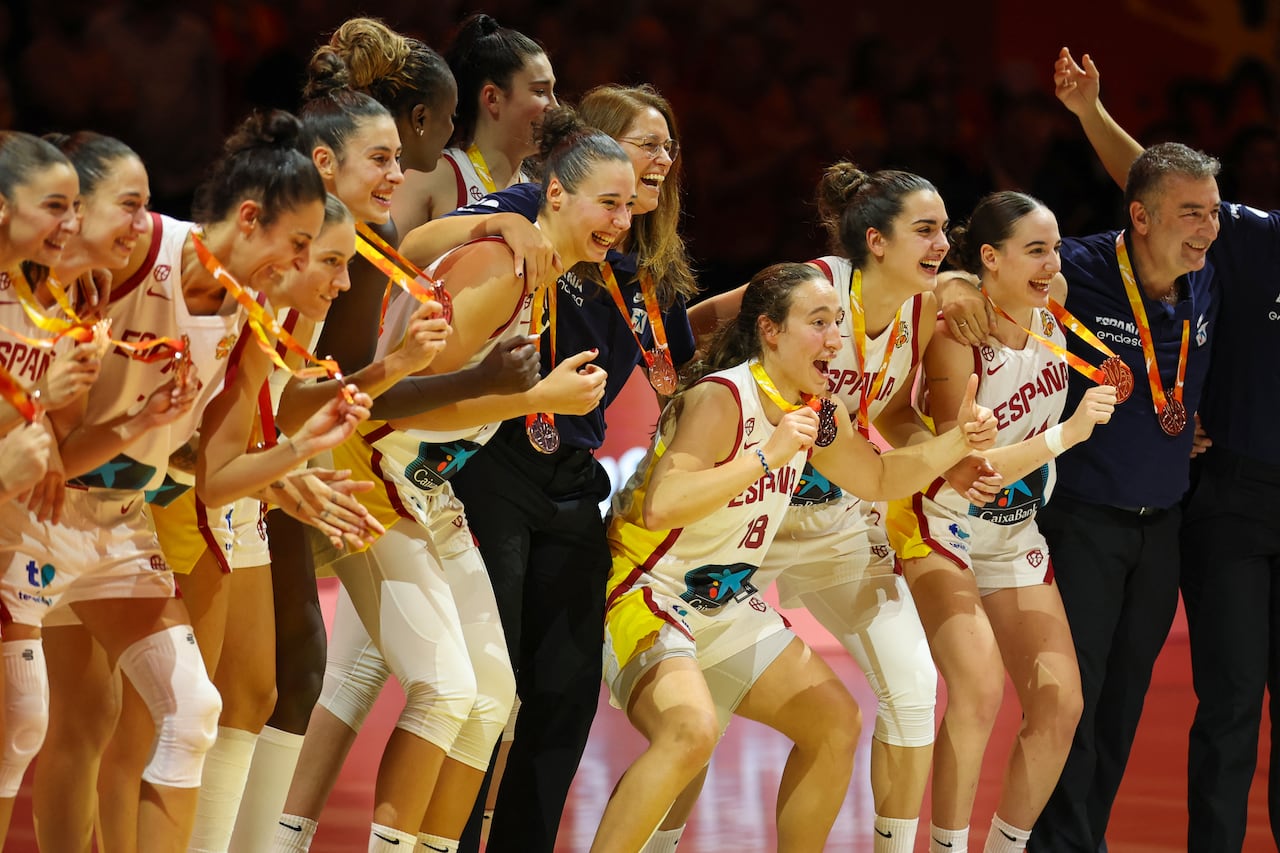
Spain’s team poses with their bronze medals after defeating Germany in the 2026 FIBA Women’s Basketball World Cup third-place game in Berlin on Sunday. (Odd Andersen/Getty Images)
Germany had hoped to secure its first medal in the tournament during its second appearance as a unified nation, including its last time as a host in 1998. East Germany finished fourth at the 1967 tournament.
This marked Spain’s second victory over Germany after they had previously won by 30 points in their opening match — Spain’s largest win over a European team and Germany’s most significant defeat in the competition.