
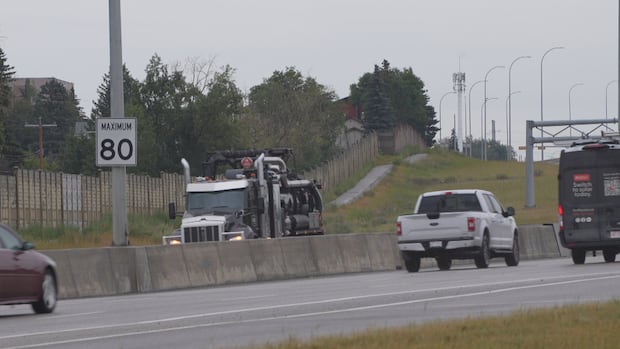

Residents in the southeastern neighborhood of Riverbend are expressing worries about the traffic noise along Glenmore Trail, claiming that the current sound wall is insufficient in blocking the disturbances.
“It’s so loud that my kids complain when their windows are open,” mentioned Riverbend local Nichole Walczak. “Sometimes the noise even wakes them in the middle of the night or during the early morning hours.”
Another resident, Amanda Blackmore, remarked that having guests over has become “embarrassing,” as conversations in the backyard require shouting to be heard.
“You can’t hear each other, so I’m constantly yelling, and then people don’t want to come back because it’s uncomfortable trying to have a nice conversation with all that noise in the background,” she explained.
A sound barrier intended to diminish traffic noise is located along the expressway adjacent to the community.

Nichole Walczak (left) and Amanda Blackmore (right) avoid spending time with family and friends in their backyards due to disruptive traffic noise. (Brendan Coulter/CBC)
However, locals argue that it is no longer effective in mitigating noise, and they are urging the city to either increase its height, width, or replace it altogether.
“We have noticed that the noise has increased dramatically, and we’re trying to collaborate with the city to find solutions to reduce the sound,” stated resident Kathleen Schroeder.
Schroeder shared that she and her neighbors have taken measures to lessen the noise themselves, such as installing double or triple pane windows, sleeping in different parts of their homes, or using thicker curtains to absorb some of the sound.
“We try to leave our homes, go for walks, and keep our distance from the wall. But that’s all we can do for now,” she added.
Both Schroeder and Blackmore noted that the area was significantly quieter prior to the completion of the Glenmore Trail widening project in 2019. They attribute the increased noise levels to the city’s expansion, which has led to a rise in traffic.

Kathleen Schroeder from Riverbend has requested that the city perform a noise assessment in the area. The study revealed that sound levels in one part of the community surpassed the acceptable threshold of 65 decibels for residential areas. (Brendan Coulter/CBC)
In June, the city commissioned a traffic noise evaluation in the neighborhood, finding that sound levels in one location exceeded the permissible 65-decibel limit for residential zones.
Schroeder initiated the request for the assessment, which residents can pursue through the city’s noise barrier program. She expressed that the results of the study validated her concerns.
“I felt reassured, like I wasn’t just an overly concerned citizen,” she remarked.
The city’s website states that “noise barriers are identified for replacement or repair based on condition survey data,” and they are prioritized according to the available budget.
The municipality claims it conducts regular evaluations of noise barriers, inspecting those in good or acceptable condition every two years, while barriers in poor condition are evaluated annually.
A list is subsequently compiled of noise barriers that require replacement or repair.
During the 2023-2026 budget cycle, city council allocated $6.12 million for noise barrier repair and replacements.
However, Riverbend is not the only area facing issues with excessive noise. The study identified six additional neighborhoods that qualify for noise barrier upgrades.
-
City launches new traffic safety initiative targeting excessive vehicle noise
-
Traffic noise in Riverbend renders backyard ‘almost useless,’ says resident
The city mentioned that these locations will be prioritized based on noise levels, the number of affected residents, and the funding approved in the next budget cycle.
For Schroeder, she hopes for prompt changes but considers the assessment a positive first step.
“Knowing that the city has recognized that noise is an issue was a significant move forward towards finding a resolution for this problem.”