
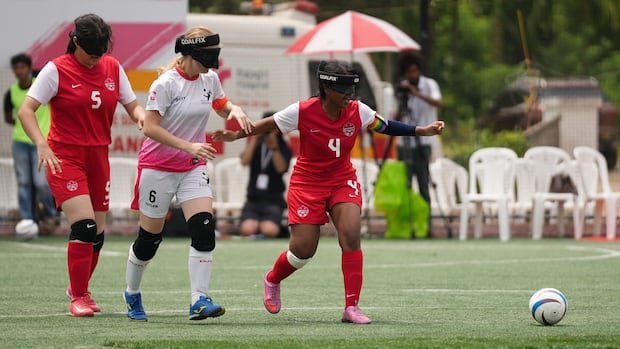

Blind soccer is a unique sport characterized by its distinctive sounds. The field echoes with the sound of an audible ball, equipped with jingling bells for players to track its movement. The game relies heavily on auditory cues, with each team fielding five players, all wearing eyeshades to ensure a level playing field.
In this modified version of soccer, the sighted goalkeeper provides direction from the back, while a guide behind the opposing net directs attackers. Players must shout “voy,” Spanish for “I go,” to signal their movements and avoid collisions. For Canada’s women’s blind national team, the unfamiliarity of the sport presents a challenge.
Over the past decade, the Canadian program has introduced blind soccer to a wider audience, cultivating a competitive team. The team is set to compete against Argentina, Mexico, and Brazil in the IBSA Women’s Blind Football American Championship in São Paulo from September 3 to 9. Since 2017, the sport has seen significant growth in Canada, with approximately 30 competitive players nationwide, thanks to workshops and community sessions that have engaged over 3,500 individuals.
Captain Hillary Scanlon, who unexpectedly lost her vision in 2016, discovered blind soccer online and found her way to Matt Greenwood, a key figure in developing the sport in Canada. Despite facing obstacles such as limited equipment like echo boards, the team perseveres. Scanlon’s determination has seen her travel long distances for training, reflecting the challenges of expanding the sport in a vast country like Canada.
After establishing official recognition from Canada Soccer in 2025, the national team has received support, including funding for training camps and international competitions. While the journey to Brazil for the upcoming tournament involves individual fundraising efforts by the players, the progress made in establishing a national team marks a significant achievement for the sport in Canada.